
10 Technical Skills Every Forward Deployed Engineer Should Have
Introduction
Technical Skills Every Forward Deployed Engineer Should Have modern-day companies require more from a software engineer than ever before. They need professionals who know how to interpret business requirements, have a strong understanding of different technologies and approaches, connect disparate systems, and create products that are actually built and working in the real world.
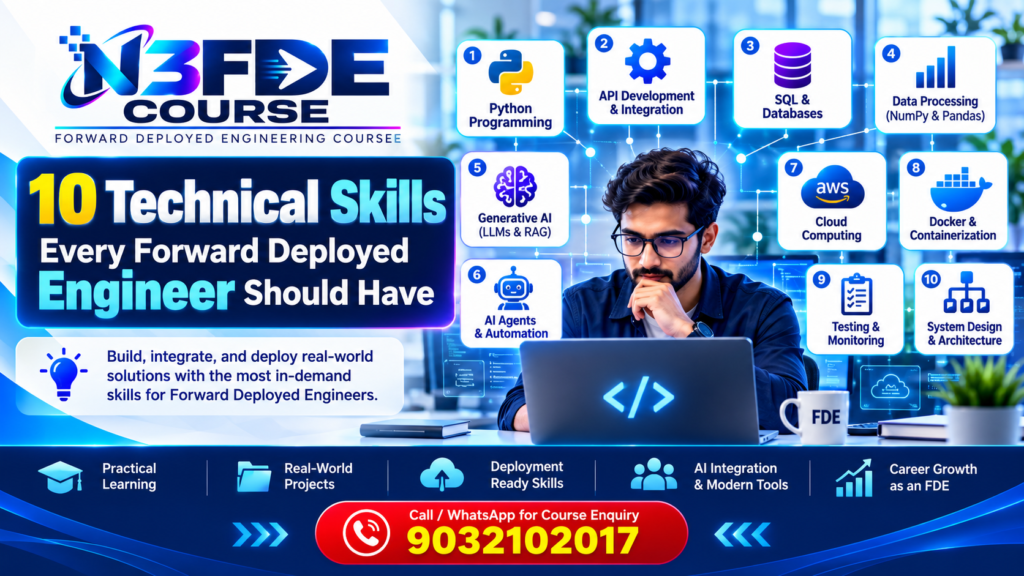
This is why companies now need forward deployed engineer
A forward-deployed engineer works with customers and product teams to provide software developments and systems needed to fulfill business objectives. For instance, let’s say there is a financial institution that wants to build an automated process for reviewing applications for loans.
Python Programming and Application Development
Python is one of the most popular programming languages used nowadays to create applications for automating business processes, developing systems’ back-end, analyzing data, and building artificial intelligence.
For FDEs, Python is an effective tool that allows them to shape their ideas into working applications.
Core python concepts
- Variables and data types.
- Conditional statements and loops.
- Functions and modules.
- Lists, tuples, sets, and dictionaries.
- Object-oriented programming.
- Exception handling.
- File handling.
- Decorators and generators.
- Asynchronous programming.
- Working with external libraries.
Real-world application
An insurance company may get thousands of claims each month. Many employees should review the details of each customer’s request, verify the provided documents, and ensure that all the required information is present.
A Python developer can create an application that can read customer data, check for the presence of necessary fields, detect errors, and collect all the valid information for further processing by the clerks.
Tools to learn
- Python.
- VS Code or PyCharms.
- Jupyter Notebook.
- Virtual environments.
- Python package manager.
Practical project: Build a customer record validator using Python, file processing, functions, and exception handling.
How These 10 Technical Skills Work Together
An FDE rarely uses one technology. Usually, an application involves multiple interrelated skills.
For example, let’s imagine that we need to build an application that processes invoices automatically. A possible set of activities for such a project is given below.
- Development Stage Required Skills and Technologies
- Understand the business requirement Requirement analysis and system design
- Process invoice files Python, Pandas, and document processing
- Extract and validate information AI integration and Pydantic
- Store invoice records SQL and PostgreSQL
- Expose application functionality FastAPI and REST APIs
- Automate approval workflows Workflow automation and AI agents, where appropriate
- Package the application Docker
- Deploy the solution Cloud computing
- Verify application behavior Pytest and API testing
- Monitor and troubleshoot Logging and monitoring
This example shows how a complex business application that integrates multiple features can be built using several skills that an FDE may acquire.
Recommended Learning Roadmap for FDE Beginners
FDEs need to acquire a significant number of skills, but it is advisable to start with one programming language first (Python in this case) and gradually move to more complex concepts and tools.
Stage Topics Practical Outcome
Stage 1 Python fundamentals and OOP Build reusable business logic
Stage 2 NumPy, Pandas, and SQL Process and manage business data
Stage 3 FastAPI, Flask, and Pydantic Develop backend APIs
Stage 4 Git, Linux, and Pytest Collaborate, test, and troubleshoot
Stage 5 AI, LLMs, and RAG Build intelligent applications
Stage 6 AI agents and workflow design Automate multi-step processes
Stage 7 Docker and cloud platforms Package and deploy applications
Stage 8 System design and integration Connect complete application components
Stage 9 End-to-end capstone projects Demonstrate practical engineering skills
The time needed to complete each stage depends on the learner’s background, the amount of time that can be dedicated to the task, and the complexity of the selected project.
Real-World FDE Project Ideas
Projects are an integral part of the learning process because they allow one to combine different skills and see how a particular application might be built in practice.
Conclusion
Forward Deployed Engineering enables me to combine my knowledge of software development with practical applications and considerations.
Python, APIs, databases, data warehousing, AI, cloud computing, Docker, testing, and system design are all essential components that contribute to the entire cycle of application development and operation.
However, I believe that the new knowledge needs to be integrated into practice by building small applications, adding features and external services, and ultimately completing an end-to-end project that addresses a practical business application. Thus, the ability to design and develop an application to the point of having it address real-world business needs is a desirable skill to have as a Forward Deployed Engineer.
ADDRESS:
Flat 515, Fifth Floor, Annapurna Block, ADITYA ENCLAVE, Kumar Basti, Ameerpet, Hyderabad, Telangana 500016
PHONE NO : 9032102017