
Introduction
A Forward Deployed Engineer (FDE) operates in the frontline, interacting directly with customers, understanding their problems and implementing solutions. This job requires a solid technical foundation, including three competencies: Python, APIs and cloud.
These skills can be combined to produce virtually any solution a client might request. A lack of any one of these skills will be acutely felt during the implementation.
Why Technical Foundation Matters
It is easy to think that an FDE needs to know about all possible tools and languages out there. However, in reality, an FDE only needs a few key competencies that can be combined together to solve a class of problems.
Imagine a typical week: on Monday, a client brings a problem requiring to collate and massage some data from three systems. By Wednesday, you understand the data well enough to build a simple service that carries out the transformation. You deploy this service by Friday, so that the client can start interacting with it from Monday again.
This process involves a range of activities that fall under the umbrella of the three core skills.
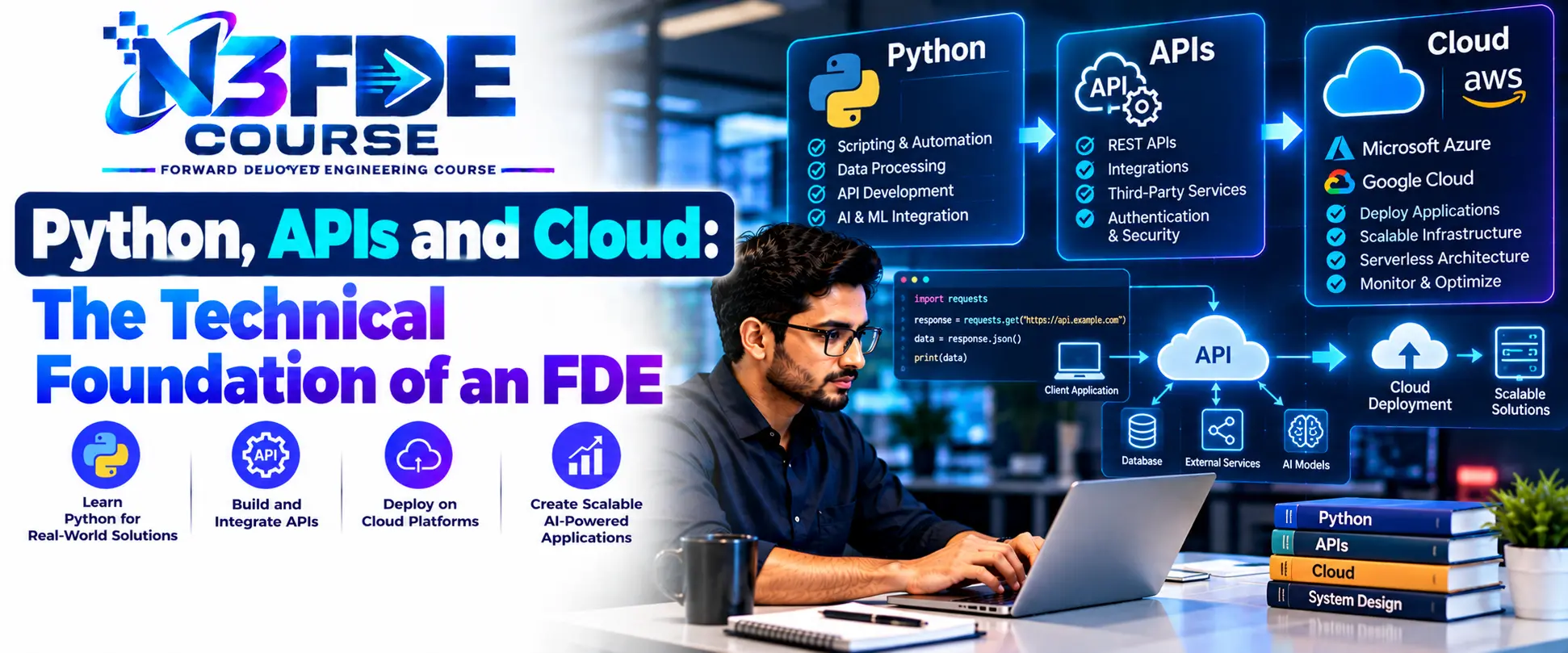
Python: The Language You Will Use Every Day
Python is probably the easiest language to learn, given its natural syntax and extensive libraries. This makes it ideal for the kind of agile development required by an FDE.
An FDE will typically leverage Python in the following ways:
Data cleansing and wrangling using pandas
Building lightweight automation and backend services with FastAPI or Flask
Running and interacting with AI models
Experimentation and rapid prototyping of any solution
Python’s power lies in its ability to reduce the time to value: every client-facing activity will benefit massively from being able to write working code in a matter of hours or days. In this regard, knowing Python is an absolute must.
However, writing code that works is only half the battle: an FDE also needs to write code that other people can understand. It is surprising how many problems can be prevented simply by writing clean code with descriptive variable names and functions. In many cases, the audience for this code will be the client themselves: code readability is paramount.
What to Learn First
The best way to approach Python is to learn the fundamentals first. Then, learn how to interact with JSON data, which is ubiquitous when dealing with APIs. After that, practice using third-party libraries such as requests, pandas and pydantic. Finally, practice reading and understanding someone else’s Python code – this is an invaluable skill that will serve you well in your FDE career.
The API: How Systems Talk to Each Other
An API (Application Programming Interface) is a set of rules that allows two computer programs to communicate with each other. Modern software relies heavily on APIs: a typical enterprise application can communicate with dozens of other systems using a range of APIs.
As an example, consider a typical retail business: their order management system, CRM and payment processing all communicate with each other through APIs. An FDE will need to be comfortable both with writing and consuming APIs.
The API Skills That Matter Most
For an FDE, it is not necessary to be an API expert. Here are the most common API-related tasks that come up in an FDE’s work:
Understanding the principles of REST APIs
Authenticating and authorizing API requests
Handling errors and edge cases
Dealing with rate limiting
Consuming webhooks
When working with clients, an FDE will often encounter bespoke solutions. For example, one API may return data in a different format than expected, or become unavailable at a critical moment. A competent FDE will always build in contingency around such eventualities.
Most importantly, APIs represent the connection to the modern world: specifically, generative AI. In practice, this means that an FDE will consume a large language model (LLM) through an API. Similarly, an AI chatbot for the client will be built on top of an LLM and connected to the client’s systems via APIs.
The Cloud: Where Your Work Goes Live
A prototype on your laptop is nice, but the client will want to see a production-ready solution. This usually means deploying the solution somewhere on the cloud.
Cloud providers such as AWS, Azure or Google Cloud offer infrastructure where applications can be deployed and scaled. The cloud gives an FDE the ability to focus on writing code, rather than operating servers.
Cloud Skills Every FDE Needs
The good news is that you do not need to know everything about the cloud! Here are the most common activities an FDE will carry out on the cloud:
Deploying Python scripts or services on virtual machines or containers
Storing data on cloud databases and file systems
Using containers to package and deploy applications consistently
Configuring networking and security settings
Monitoring applications and infrastructure
Security is of paramount importance when dealing with clients’ data: it is vital to learn how to handle secrets and permissions securely. One wrong step here can compromise years of goodwill with a client.
A competent FDE will also know the importance of deployment practices: it is better to deploy often and in small increments, rather than risk everything in one go. This mindset will help you sleep soundly after particularly important deployments.
How the Three Skills Work Together
Let’s see an example of these three skills working together. A logistics company wants to improve its on-time delivery performance.
An FDE would approach the problem as follows: use Python to get and manipulate the company’s data, consume the company’s tracking API to enrich the data, then build a scoring model and wrap it up in a service that can be deployed on the cloud. Finally, this service can be connected to the company’s dashboard via an API.
It is evident that none of these steps would be possible without a solid foundation in all three areas. That is why the FDE role is so special: it is the only role that requires end-to-end technical competence.
Beyond the Code: The Human Side
A strong technical foundation is not everything: an FDE also needs to be a good communicator, able to explain complex concepts in simple terms. It is surprising how often an FDE’s job description includes teaching some technical skill to the client.
But the more fundamental point is that good technical fundamentals breed confidence. The more you know about a topic, the less scary it will be to deal with its intricacies. This will help you immensely when dealing with complex customer problems.
How to Build This Foundation
The best way to learn is to actually build something. Here are some suggestions to practice your FDE skills:
Learn the fundamentals of Python, then build three simple Python scripts.
Practice calling public APIs and handling errors.
Build a small FastAPI service and deploy it.
Package your service in a Docker container.
Deploy the service on a cloud provider. Try doing this on a regular basis, and see how you improve.
If you are looking for more structure, a good alternative is to join an organized, project-based course.
Final Thoughts
Python, APIs and cloud constitute the technical triad of an FDE. These skills can be combined in myriad ways to solve customer problems. Anyone aiming to become an FDE would do well to develop these skills.