
Introduction
Like all good roles, the Forward Deployed Engineer (FDE) was born out of a need. This need was that great software was being produced, but it was failing in the real world. Despite customers buying powerful products, they were unable to use them effectively.
Companies needed someone to bridge that gap, and the FDE role was created. The role has evolved substantially since its creation, becoming one of the most talked-about jobs in tech.
Let’s explore that evolution, from writing code to writing customer value.
Where It All Began
The concept of deploying engineers on the customer side is not a new one.
Early enterprise software sellers learned quickly that while their products may work, that doesn’t mean that they will integrate well with their customers’ systems. This is especially true when dealing with messy legacy data.
To handle this, some forward-thinking companies began deploying engineers directly into the client’s camp. These engineers would be responsible for helping to tweak the product to work in the client’s environment. This is how the company Palantir, and the term “forward deployed,” became famous.
As such, the role of the FDE began to acquire a certain cachet, due to its focus on action and speed.
Early Days: Code First
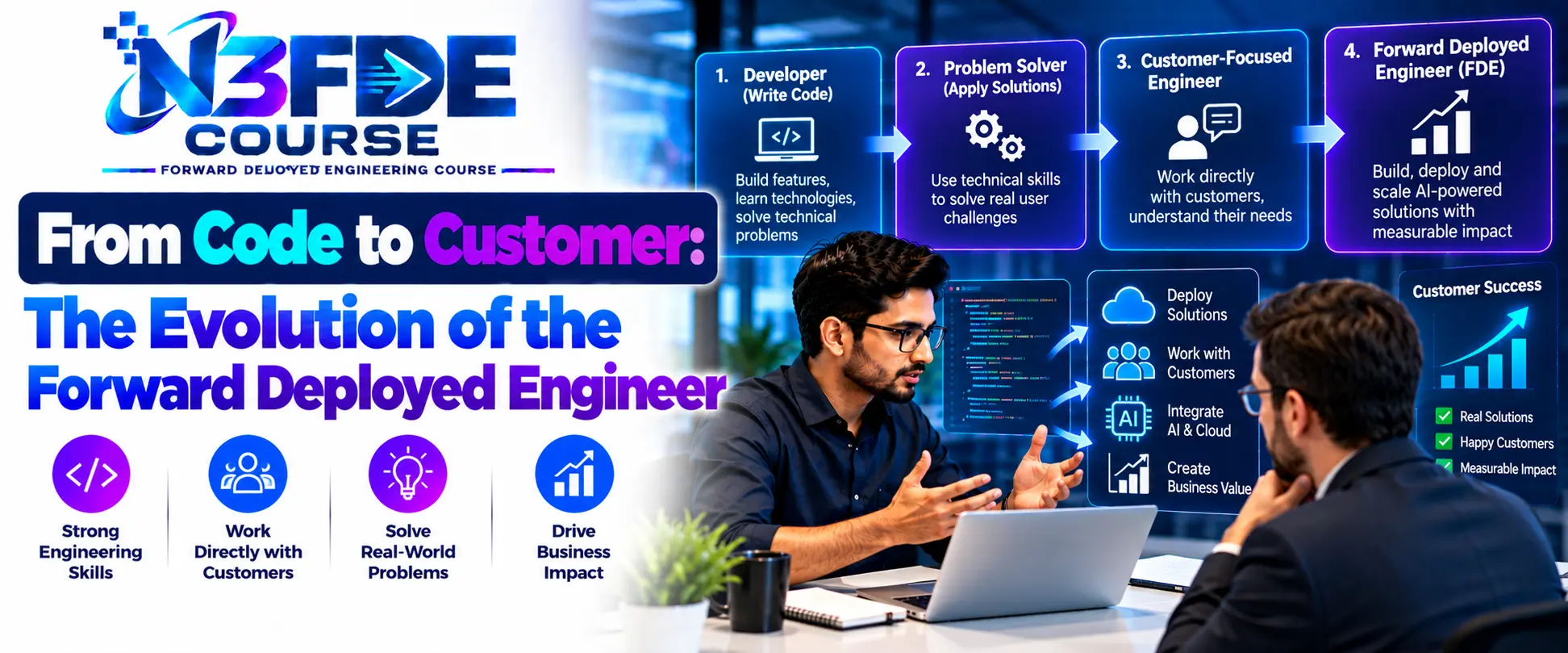
The early years of the FDE were defined by their dual nature. The ideal candidate for the role was someone who could write excellent code and knew how to deal with customers.
The former skill was more important, however, as the FDE’s primary function was to deploy and tweak code. They would write integrations, debug and modify the product as needed, and get it to work in a new environment.
While they were expected to be able to communicate with the client, that wasn’t their main responsibility. If the code worked, everyone was happy.
The problem with this approach was that the FDE became a “solution” to the customer’s problems, rather than a true partner. They were good at fixing the issues described, but not at identifying the real ones.
Shifting Toward the Customer
Another weakness of the early FDE was that the customer-facing qualities of the role weren’t valued. As such, many FDEs were hired without proper training in listening to the client.
This caused them to miss opportunities to advise the customer or to identify their deeper needs. In some cases, an FDE would miss the forest for the trees.
The best FDEs were those who could listen to the client and identify their real needs.
As such, as the years went by, the customer-facing qualities of the role became more important. The FDE began to take part in discovery calls, negotiations, and setting expectations.
They became a full partner in delivering value to the clients, even becoming involved in post-launch activities. As such, being an FDE became a sought-after position, as it gave one the ability to build lasting relationships with clients.
The Evolution of the Role Through Technology
The evolution of technology also played a part in shaping the FDE role. Cloud technologies allowed for easier and faster deployment of products. As such, an FDE didn’t have to spend as much time setting up infrastructure.
They were able to spend more time writing code and interacting with the customer. This became even easier with the advent of Application Programming Interfaces (APIs).
Due to their prevalence, an FDE could use them to tie together different elements of the client’s stack. This allowed the FDE to deliver much more complete solutions. They could build an entire system around the product, using only Python and an API.
This further increased the value of the FDE and the scope of their contributions.
The Advent of AI
With the advent of generative AI, the FDE role changed yet again. Due to the enormous interest in AI by all industries, companies began expressing interest in adding AI features to their products.
The problem was that they didn’t know how to do it. They had no idea how to extract their data, what to ask of the AI, or what would give them the most value.
This created an enormous need for FDEs who could guide them through the process.
Today, an FDE Can Expect to Do the Following:
- Build retrieval systems that allow AI to read the company’s documents.
- Create agents that can perform complex tasks.
- Perform audits and guardrails for AI to avoid hallucinations.
- Connect language models to the company’s tools using APIs.
- Train the company’s employees to use the new AI systems.
The most successful FDEs are those who can advise the client on AI’s capabilities, and when it can be replaced by simpler rules. This earns the FDE tremendous brownie points with the client.
The Current State of the FDE Role
An FDE today embodies a number of roles. They are an engineer, capable of writing Python scripts and deploying them on the cloud.
They are also an advisor, helping the client understand complex issues. An FDE is also a salesman, explaining their complex offerings in simple terms. Finally, they are a project manager, helping roll out the product in an organized manner.
Let’s Take a Look at What the FDE Role Entails Today
The main skills of an FDE can be summed up in the following:
- Engineer: Proficiency in Python, APIs, cloud, and AI technologies.
- Consultant: Empathy and understanding of the client’s needs.
- Execution: Speed of deployment of working solutions.
- Communication: Ability to explain complex ideas in simple terms.
- Ownership: Drive to fix the issue and deliver value.
Most importantly, a good FDE is able to take what they have learned on the ground and incorporate it into the product. This allows for features to be built that provide demonstrable value to the client.
The Future of the FDE and Your Career
The FDE has come a long way since its inception. Through the years, it has evolved and adapted to the changing environment.
As companies began to use cloud technologies, APIs, and AI, the FDE was there to help them adopt these technologies.
The increasing complexity of the product meant that a true expert in the product was needed on the customer side. This expert would be able to help the client to derive value from the product.
The FDE role is also an extremely valuable one to the company. It is a customer-facing role, and as such, it is vital to the company’s revenue. Furthermore, the FDE is one that can evolve with the company.
An FDE Can Grow Into the Following Roles
An FDE can grow into a solutions architect, product manager, AI engineer, or founder of their own company. Finally, the FDE role is extremely valuable across industries and will continue to be so.
How to Prepare Yourself for an FDE Role
The long road of evolution for the FDE shows that the role will continue to change. Furthermore, it shows that the role is extremely valuable and will continue to be so.
If you are considering a move toward the FDE, or want to build your own FDE career path, you are in the right place. To start preparing yourself for this role, you should begin learning Python and practicing your skills.
Next, you should build some small projects and applications that consume some APIs.
Finally, you should build something valuable using cloud technologies and AI models.
But perhaps the single most important thing you can do for the FDE role is to practice explaining your projects and applications to someone who doesn’t have a technical background.
This will hone your communication skills and prepare you for explaining your product to the client.
A Final Word on the FDE Role and Career
The FDE has evolved considerably since its creation. It transformed from a coder into a full-fledged partner to the client.
Cloud technologies, APIs, and AI all contributed to this evolution by expanding the scope and capabilities of the FDE.
However, the fundamental qualities of the FDE continued to revolve around empathy for the client and providing demonstrable value. If you are considering this exciting career path, you should begin preparing yourself today.
Start with the code, and then build out your interpersonal skills.