
Introduction
Jobs in the tech sphere tend to be fairly similar. Two popular career paths are Forward Deployed Engineer and Data Engineer. Both are involved in coding and data analysis and require technical skills in general.
However, they are rather different in their day-to-day duties and preferred working styles. One has a higher focus on customers and speed, while the other concentrates on data and systems. Below, the two professions are compared in detail to help make a choice.
Forward Deployed Engineer Overview
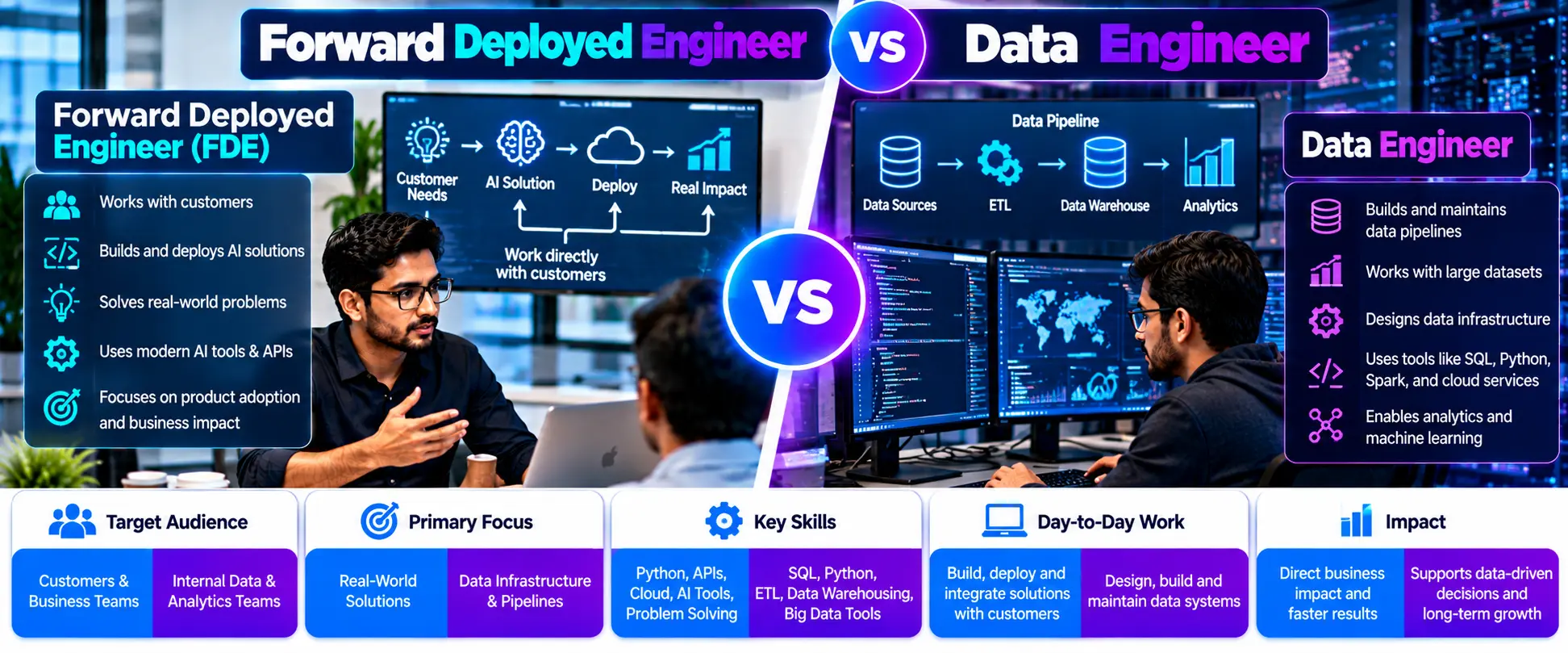
A Forward Deployed Engineer is a specialist who helps customers solve specific problems. They work closely with clients, studying their issues and developing solutions. After implementation, an FDE is there to ensure everything works smoothly.
A representative of this profession may have to perform the following tasks:
- Consult with clients on a daily basis.
- Write Python code for API development.
- Construct an AI feature, like a chatbot or search.
- Deploy the newly developed solutions.
- Take clients’ feedback and update the products.
Thus, an FDE works in the sphere of cutting-edge products, addressing a particular client’s issue. They aim for speed and customer satisfaction and are highly solution-oriented.
Data Engineer Overview
A Data Engineer is a database professional who is responsible for constructing and maintaining systems for storing and processing information. All companies need somebody to collect and regulate data, and these specialists are in great demand.
A Data Engineer may have to:
- Design data pipelines.
- Write code for transforming raw data into processed data.
- Watch over data pipelines and resolve issues.
- Make sure that the data is correct and safe.
Their work allows other professionals, like analysts and data scientists, to do their jobs. A Data Engineer normally works behind the scenes, constructing systems and ensuring smooth operations.
Comparing Forward Deployed and Data Engineers
In general, the similarities between the two professions are limited to the technical skills required. Other aspects of the jobs are rather different, and the main contrasts are described below.
Main Focus
An FDE prioritizes customers and their needs. A DE focuses on data and systems.
Collaboration
An FDE spends more time communicating with clients. A DE collaborates with internal stakeholders.
Work Pace
An FDE is deadline-driven and works fast. A DE constructs reliable solutions and products.
Outcome
An FDE provides working solutions for recognized issues. A DE produces trustworthy data sets and systems.
An FDE travels and attends meetings frequently.
Therefore, when an FDE constructs a solution for a client, their main goal is to help this particular customer. They are not concerned with other users and just want to solve the current issue.
A DE is different in that they work on data sets. They may help multiple data scientists, but their primary mission is to make sure the information is accurate and properly transformed.
Skills for a Forward Deployed Engineer
An FDE requires a broad knowledge of programming and software development. The main skills to acquire for this job are:
- Python: To construct solutions rapidly.
- APIs: To communicate with other software.
- Cloud: To deploy applications.
- AI/LLM: To build chatbots, recommenders, and search engines.
Additionally, FDEs should be good at explaining complex concepts to users in simple terms. Their technical expertise is only part of the job, as they also need to address clients’ issues.
Skills for a Data Engineer
A Data Engineer should possess a diverse set of competencies related to data warehousing and processing. The key skills to learn for this job are:
- SQL: The basics of databases.
- Python/Scala: To build data pipelines.
- ETL tools: To process and transform data sets.
- Data warehouse: To store and manage information.
- Data modeling: To structure data sets for easier access.
A DE should be excellent at data transformation and validation, as one mistake can lead to all reports being incorrect.
Working in Forward Deployed and Data Engineering: A Day in the Life
An FDE normally works with customers, identifying their needs and constructing solutions. For instance, an FDE called Asha has a logistics client that is struggling with timely deliveries.
On Monday, they discuss the issue, and by Wednesday, Asha has developed a small application that can predict delays. On Friday, the solution is deployed and presented to the client, who now has a functioning product.
In general, an FDE can deploy working solutions rapidly, addressing customers’ issues.
An example of a DE is a person called Ravi, who works on a data pipeline that would help the company store and organize sales data better. They spend the week designing the system, transforming the data sets, and testing the correctness of the results.
After that, they schedule nightly runs of the pipeline, and no one sees the effort put into it.
Career Growth and Opportunities
Both jobs are promising, but they normally lead to different directions. An FDE can grow to a senior FDE, solutions architect, product manager, or AI engineer.
More interestingly, this career path can lead to a founder position since one becomes familiar with clients’ primary concerns. This career choice is flexible and can provide multiple opportunities.
As for a DE, they can be promoted to a senior DE, data architect, or machine learning engineer. Additionally, one can move to a managerial position, like an engineering lead. This career choice is also versatile, though it may not lead to interacting with clients as often.
It is also important to note that the two professions complement each other. An FDE who knows data fundamentals will be significantly more successful in their practice.
Similarly, a DE with client-facing skills can move to an FDE position, becoming more versatile and valuable. Thus, it may be helpful to consider both options and gain the basic skills of the two.
Which Career to Choose: Forward Deployed Engineer or Data Engineer?
When choosing between an FDE and DE, it is important to assess which aspects are the most appealing.
An FDE is a great choice if someone enjoys speed and variety, prefers to work with people, and wants to see the results of their efforts rapidly. Additionally, this track is suitable for those who are willing to travel and attend meetings.
A DE is a great choice if someone prefers to work on larger-scale issues, find better ways to store and process information, and contribute to multiple projects. They may be a good fit for those who prefer fewer meetings and more focus on the task at hand.
Both these careers have their own advantages and disadvantages, but ultimately, it is a personal choice to make based on individual preferences.
Whoever chooses to enter the tech sphere should remember that practice makes perfect, and it is important to gain experience actively. Below, there are a few common recommendations for aspiring FDEs and DEs.
How to Get Started
Those interested in the FDE track should start by learning the basics of Python, practicing coding regularly, building applications with APIs, deploying apps to the web, and learning RAG and language models.
Additionally, they may want to take on the challenge of building an application for a small business.
Those interested in the DE track should learn the fundamentals of SQL and Python and build a data pipeline with Airflow. After that, they should try deploying the pipeline to a cloud warehouse.
Once the basics are mastered, one should try to gain practical experience to develop skills further.
Conclusion
Overall, both Forward Deployed Engineers and Data Engineers play a critical role in the tech sphere.
An FDE helps customers solve pressing issues and deploy working solutions rapidly. A DE focuses on ensuring the accuracy of data sets and building reliable systems for storing and processing information.
Ultimately, the choice between these two is a matter of preference. Those who enjoy people-facing communication and working on specific clients’ issues may want to consider the FDE track.
Those who enjoy working on larger-scale problems and find satisfaction in reliable solutions should explore the DE career.