
In enterprise software development, mastering AWS Python deployment through a dedicated Forward Deployed Engineer course has become an established practice. Forward Deployed Engineers work directly with customers on their boundaries. Consequently, these are not typical backend developer roles because FDEs design custom data bridges, negotiate security requirements, and execute code in restricted environments.
Delivering value in such contexts requires a deep understanding of the specific demands of these hybrid environments. Teams must rapidly develop and iterate solutions in an agile manner. Meanwhile, these systems must demonstrate enterprise-grade stability and scale horizontally. Python offers the development agility needed to work with heterogeneous data and API formats, and AWS provides the infrastructure to host enterprise-grade solutions.
Architectural Principles: Why AWS and Python?
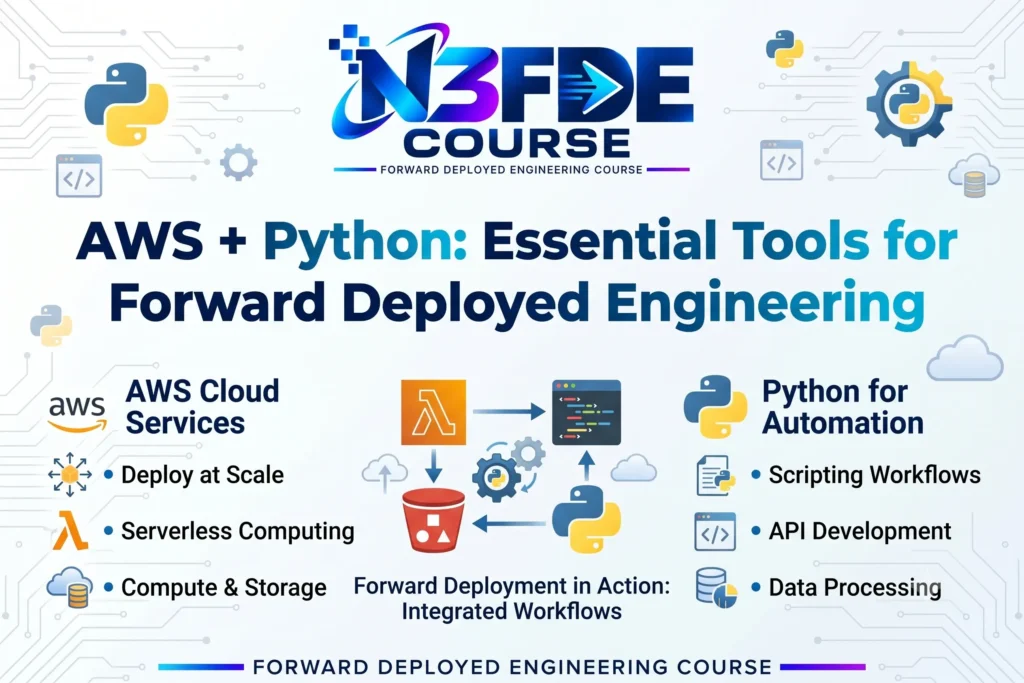
Customer environments are highly diverse. Some customers accept raw extracts of legacy data dumps in heterogeneous formats. Alternatively, others require teams to install webhook endpoints directly into data processing pipelines. Python allows such integration points to be implemented without friction.
At the same time, AWS provides key infrastructure building blocks that allow FDEs to focus on their mission:
-
Authentication and Identity: AWS Security Token Service (STS) and AWS IAM permissions model allow FDEs to implement their authentication and permission logic at the lowest level.
-
Declarative Infrastructure: Instead, developers write infrastructure code in strongly-typed Python classes rather than declarative configuration files.
-
Serverless Architecture: Furthermore, event-based architecture patterns eliminate idle cloud resources for long-running processes.
-
Unified Data Tooling: Engineers can apply the Python data science stack directly to cloud data warehouses and catalogues, thus enabling automated schema discovery and transformation.
Boto3 and Custom Client Integrations
The AWS SDK for Python, Boto3, is used as the primary programming interface to AWS cloud infrastructure. Writing production-grade Boto3 code, however, requires much more than just basic API familiarity.
Retry Policies and Connection Pooling
Transient connection problems, rate limiting, and API throttling become significant operational challenges for high-throughput applications. Therefore, developers must implement adaptive retries. Production-grade forward deployed applications must implement adaptive retry policies and connection pooling. This allows client code to automatically slow down retries and reduce connection concurrency when encountering external rate limiting.
Role Assumption and Cross-Account Access
Your code assumes a role granted by the client via AWS Security Token Service. Ultimately, this allows applications to use ephemeral sessions when interacting with customer resources rather than relying on static credentials.
Infrastructure-as-Code with AWS CDK (Python)
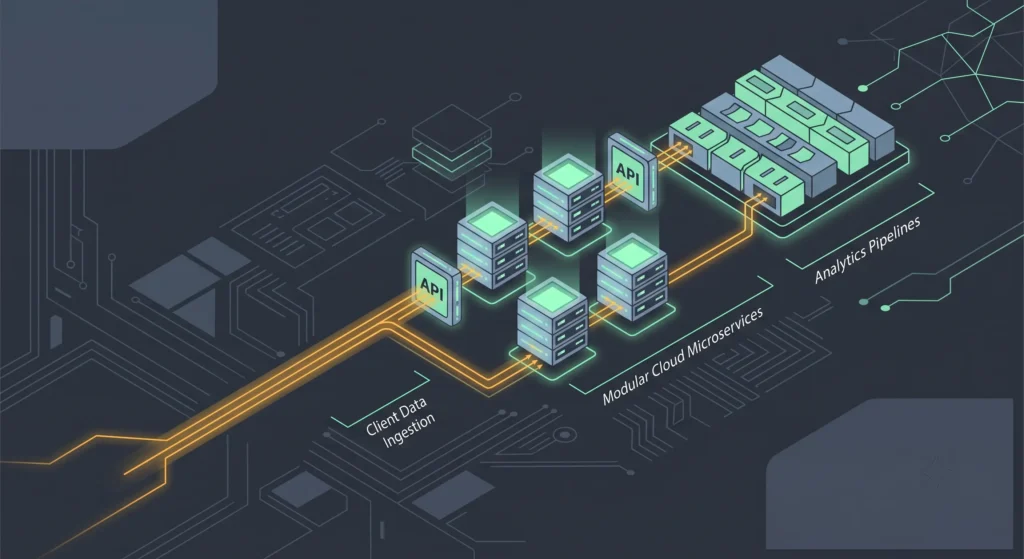
Moreover, clicking through the AWS console to create deployments manually wastes time, especially when managing dozens of customer accounts. The AWS Cloud Development Kit (CDK) allows forward deployed engineers to define infrastructure patterns as reusable Python classes.
These infrastructure “components” can then be instantiated with different sets of parameters to create entirely new AWS environments. For instance, when deploying to a new enterprise customer, an entire new isolated environment can be generated by simply passing different options to your CDK class.
Serverless Execution Model – Python Lambdas and Step Functions
Working with the serverless architecture is the most productive choice for deploying forward deployed applications. First and foremost, it allows eliminating all management and operational overhead associated with managing cloud virtual machines. Additionally, it reduces costs as no cloud compute resources are provisioned for applications in an idle state.
Lambda Powertools – Telemetry and Observability
Because customer-facing applications require strict observability, AWS Lambda Powertools for Python provides essential application insights and structured logging. These are focused on structured logging, distributed tracing, and application metrics. This allows developers to create production-grade applications that can be monitored, troubleshot, and scaled when needed.
Orchestration with AWS Step Functions
Functions in AWS Lambda are not suited to long-running processes as they have a limited execution window. For complex data transformations that require interacting with external APIs that do not support large payload transfers, or extended database transactions, AWS Step Functions can be used to chain together multiple Python function calls.
Such orchestrations allow for implementing compensating transactions, conditional branching, and stateful execution tracking for long-running processes.
Data Ingestion and Transformation – Optimized for Cloud Data
Typically, forward deployed applications process data in heterogeneous formats and convert it into target schemas for analytical databases. Reimplementing such transformations for every customer integration is extremely error-prone and time-consuming.
Data libraries, such as AWS SDK for pandas (Wrangler), allow doing all such transformations in a single call, including registering data in catalogues. For high-throughput applications, processing in pandas can be augmented with memory-efficient column-based processing libraries. This reduces overall memory consumption, thus reducing the amount of cloud compute needed to process such data.
Zero Trust and Observability Compliance
Enterprise security teams will perform regular reviews of any third-party code running in their environments. Building appropriate security and observability into the application from the start becomes table stakes for forward deployed engineers.
-
Ephemeral Credentials – Teams must eliminate long-running IAM keys and ensure all AWS calls use temporary credentials.
-
Centralized Configuration and Secret Caching – All API tokens, endpoint addresses, and other configuration secrets must be stored in centralized secret stores. These must implement in-memory caching to reduce request latency and reduce the number of API calls used to retrieve such configuration.
-
Structured, Auditable Logs – All logs must use strictly JSON format and include request identifiers that allow correlating them across services. This allows enterprise security and operations teams to use such logs for auditing and forensics.
Production Readiness Checklist and Client Handoff
Before handing over the application to the client’s engineering teams, the code should pass a series of hardening and observability checks:
-
Least Privilege Execution – All API calls must use narrowly-scoped IAM policies that only allow specific actions against specific AWS resources.
-
Dead Letter Queues – Failed events, message queue entries, and serverless function errors must be directed into dead letter queues for post-mortem analysis.
-
Environment Synthesis – The entire environment can be synthesized in an empty sandbox account, using only environment variables and other parameter stores.
-
Automated Billing Alerts – All environments must have alarms that notify administrators when excessive spending occurs.
Forward deployed engineering requires a specific set of skills. Writing code in Python and using AWS infrastructure tools allows engineers to focus on rapidly solving customer problems while still delivering enterprise-grade production applications.
N3 FDE Training
Flat 515, Fifth Floor, Annapurna Block,
ADITYA ENCLAVE, Kumar Basti, Ameerpet,
Hyderabad, Telangana 500016, India
 Phone: 9032102017