
Python Libraries Every Forward Deployed Engineer Should Know
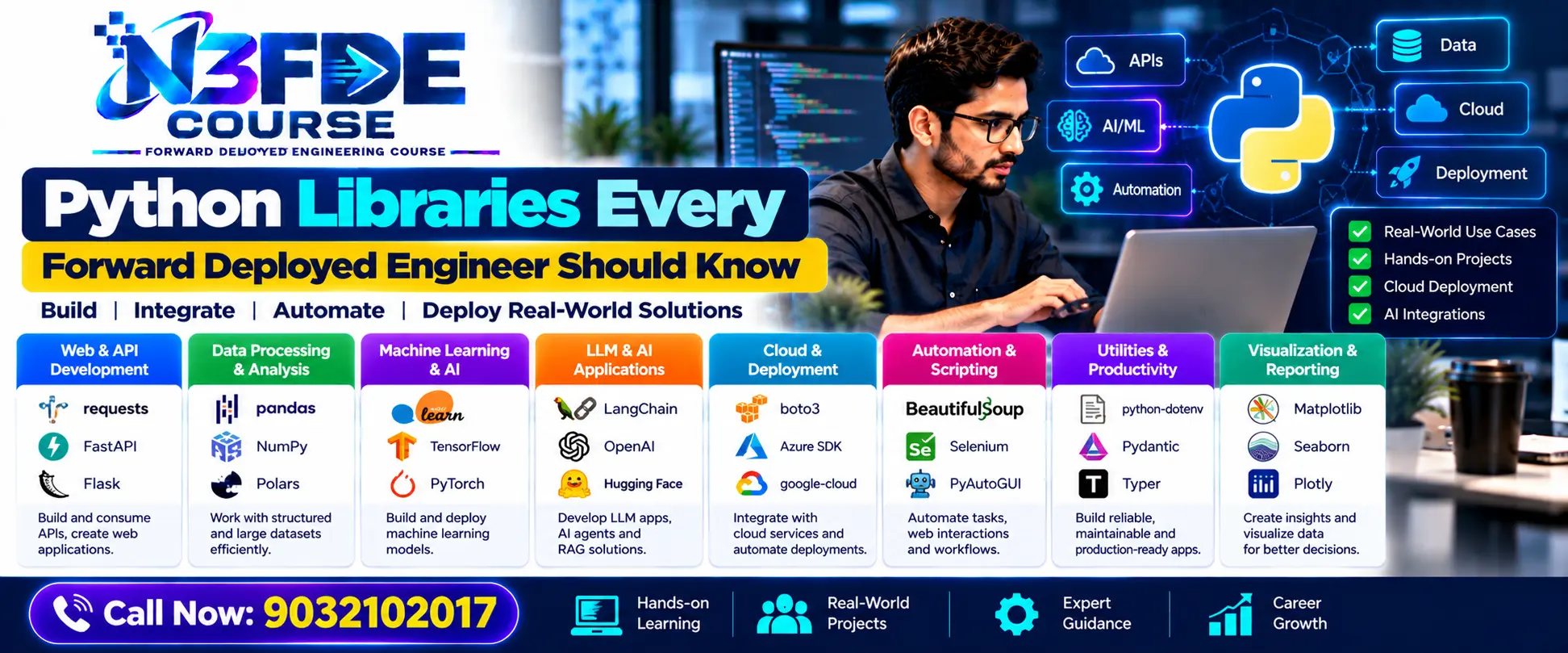
Python is the lingua franca of the forward deployed engineer (FDE). They use it to extract customer data, query APIs, develop AI features, and debug on the spot. The language itself has a simple learning curve – the true power comes from its libraries. In this guide, the author covers the Python libraries that every forward deployed engineer should know, and where each one is useful for a customer project.
Why Libraries Matter for an FDE
An FDE always works against the clock – a customer needs a working demo this week, and not next quarter. So there is no time to be writing everything from scratch.
High-quality libraries will save you hours of coding, not to mention debugging, as these tools have been vetted by thousands of developers. As such, it is best to curate a focused list of libraries to learn well, in order to combine them quickly for each project.
Requests and HTTPX: Talking to APIs
For any FDE project, an API call is practically a given. Requests is the canonical library for this task, letting you fire off a request and parse the response in only a few lines of code.
HTTPX works much like Requests, but also lets you make asynchronous requests. This lets you send off a large number of requests at once, rather than waiting for each to finish before sending the next. For an FDE working with a number of AI models, this drastically cuts down on the time needed.
Start off with Requests, and move on to HTTPX once you feel comfortable.
Pandas: Cleaning and Exploring Data
Customer data is rarely neat and tidy – the column names make no sense, dates are in five different formats, and rows are completely blank. Pandas makes short work of any messy data set, letting you load it in, filter it, combine it, and group it.
In addition, it lets you quickly and easily perform sanity checks – before you go off and engineer any features, you can see what a data set truly contains.
For larger csv or excel files, consider Polars – a faster, memory-efficient alternative that is gaining popularity among FDEs. Many engineers keep both Pandas and Polars on stand-by, depending on the task at hand.
Pydantic: Validating Your Data
Invalid data often causes strange errors, and usually at the worst possible time. Pydantic lets you define what you expect each field in a data set to contain, raising an informative error if it contains something else.
For example, you could ask Pydantic to check whether an email field contains a valid email address, catching any garbage data early on. As such, Pydantic lets you spend less time chasing down errors.
Pydantic also plays well with LLMs – for example, you can ask ChatGPT to return some structured data, and then use Pydantic to make sure that it is actually in the format you asked for. This makes AI features significantly more reliable.
FastAPI: Building Fast Services
Sometimes, the customer needs something that connects their systems to your AI model – a service which your FDE can provide. FastAPI is a quick and easy way to build these services, with built-in interactive documentation. This lets a customer’s developer easily test out your endpoints as soon as they are ready. Since FastAPI uses Pydantic for validation, the two work particularly well together.
LLM Libraries: OpenAI, Anthropic and Hugging Face
Generative AI forms the heart of many FDE projects, and the major providers offer their own SDKs. These let you make prompts and stream responses from ChatGPT, Claude or other LLMs with only a few lines of code. In addition, these SDKs handle tool calls, letting you use LLMs to query databases or perform other tasks.
Hugging Face’s Transformers library provides similar capabilities, but with a number of open-source models available. You can use these on your own data, or self-host a model on your own server. This is useful for customers who are unable to use a third-party API.
Pick up at least one provider’s SDK and become familiar with one open-source model.
LangChain and LlamaIndex: Orchestration
LLM projects are rarely as simple as plugging in a prompt – they usually have to process documents, split them up, and then pass this information on to an LLM. LangChain and LlamaIndex offer a set of tools for these document processing tasks, with LlamaIndex being slightly more focused on LLM processing.
While these libraries may add complexity to your project, they greatly reduce the time needed to get to your first prototype. However, use common sense – a simple Python script may be faster than setting up a framework.
Vector Database Clients and Embeddings
A RAG system requires a place to store embeddings, and there are a number of clients that can help. ChromaDB, Qdrant Client, and the Pinecone SDK can all be used with Python to store embeddings in a vector database. For quick prototyping, ChromaDB is useful – it takes little time or effort to set up on your local machine.
To generate embeddings, Sentence Transformers is a simple and effective library. Combined with a vector database, these allow you to build a searchable knowledge base within an afternoon.
SQLAlchemy and Database Drivers
Much customer data is stored within SQL databases, and SQLAlchemy lets you work with these from Python. This library lets you perform SQL queries, build database models, and switch between SQL dialects easily. For direct access to a database, you may want to learn a driver such as psycopg for PostgreSQL. It is important to know SQL well, and use SQLAlchemy to write expressive, safe queries.
Testing and Debugging: Pytest and Logging
Test cases seem like a waste of time, but they let you catch errors before they occur. Pytest is a simple library for writing tests, and can be used to test almost anything – for example, you could check that an API returns the correct data before a demo.
Logging, meanwhile, is a built-in Python module that lets you write informative messages to a log file. These can be incredibly useful in tracking down errors in production, and should be used liberally – but never log any private or sensitive customer information.
Handy Extras Worth Knowing
There are a number of other, smaller libraries that are helpful to know:
python-dotenv lets you keep sensitive information out of your code.
Tenacity can retry failed queries, preventing crashes due to minor issues.
Rich makes pretty text in the terminal – useful for projects with a front-end.
Streamlit lets you build simple demos with little effort.
BeautifulSoup makes parsing html and xml particularly simple.
None of these are particularly noteworthy on their own, but combined, they can save you hours that would have been spent chasing down minor issues.
How to Learn These Libraries
You do not need to be an expert in all of these libraries – a simple curriculum would be:
Learn Requests and Pandas as a foundation
Learn Pydantic and FastAPI
Build a simple chatbot with an LLM SDK
Add a RAG system with a vector database
Write tests with Pytest
By the end, you would have built a project that resembles an actual FDE project, and the skills will serve as a good portfolio piece.
Final Thoughts
The Python libraries every forward deployed engineer should know cover four areas – data, APIs, AI, and reliability. Pandas and Pydantic validate and analyze data, while Requests and FastAPI connect to outside services. The LLM SDKs and LangChain build AI features, and Pytest and logging ensure everything works. As the Python ecosystem grows, the FDE’s job will change – but the need to pick the right library for the task will always remain. Try working on a few customer projects, and you’ll be well on your way to knowing the best libraries for the FDE.