
Designing a distributed system for a greenfield consumer app on AWS is standard playbook material. However, designing that same system to deploy directly inside a defense contractor’s air-gapped on-prem datacenter is where most architects hit a brick wall.
Standard system design interviews push candidates through textbook routines. Specifically, they slap a load balancer in front of stateless pods, toss Redis in the middle, and scale out a database cluster. But in the enterprise field, those tidy patterns shatter instantly. You cannot auto-scale onto public cloud nodes when client compliance laws require PII to stay on bare-metal servers. Furthermore, you cannot rely on public endpoints when ports 80 and 443 are permanently locked down.
Enterprise companies do not need theoretical whiteboard sketches. Instead, they need Forward Deployed Engineers who can architect systems for hostile, fragmented customer environments.
An FDE specializing in system design understands how to build modular software footprints that adapt to client constraints. Thus, you design air-gapped deployment blueprints, structure fault-tolerant ingestion layers, and handle strict access boundaries.
At N3, our hands-on Forward Deployed Engineer course teaches developers how to tackle real enterprise system design problems that go far beyond standard interview prep.
Want to review our full enterprise system design syllabus or check cohort availability? Call our admissions team directly at 9032102017.
Core System Design Tenets for Enterprise Field Deployments
1. Deployment Topology: Multi-Tenant vs Single-Tenant and Air-Gapped Architectures
Enterprise buyers dictate where and how your software is permitted to run:
-
Air-Gapped & Bare-Metal Packaging: Architect software footprints that function without outbound internet access, packing all container images, model weights, and Helm charts into self-contained offline bundles.
-
Hybrid and Multi-VPC Topologies: Design split-plane architectures where control telemetry flows back to core engineering. Meanwhile, sensitive client data planes remain entirely within customer-managed AWS, Azure, or on-prem VPCs.
-
Isolated Tenancy Models: Enforce absolute data isolation using single-tenant cluster deployments or database schema-per-tenant designs to meet strict financial and healthcare compliance mandates.
2. High-Throughput Ingestion and Resilient Data Architecture
Frequently, client data streams are erratic, unpredictable, and prone to sudden burst spikes:
-
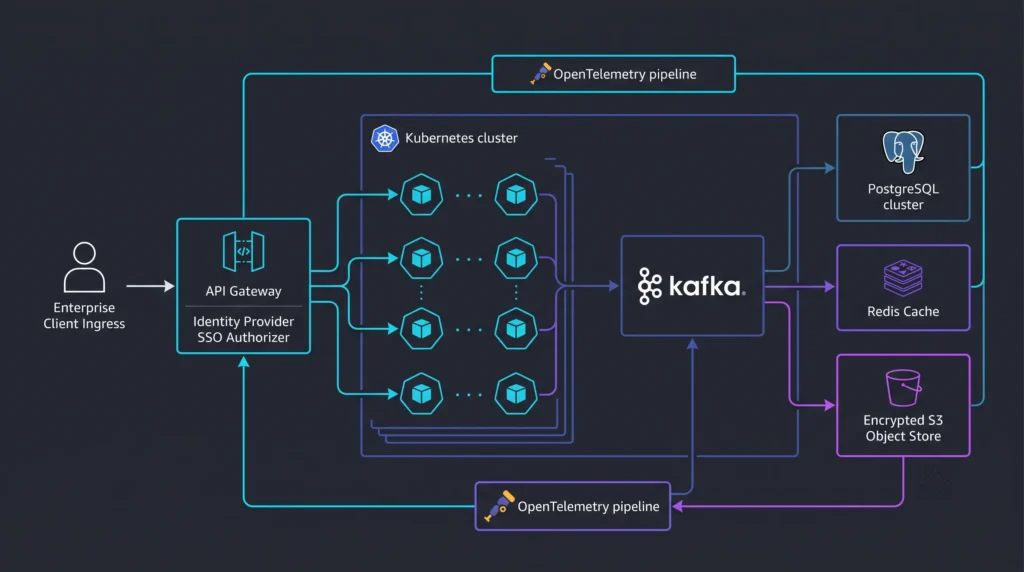
Backpressure and Decoupled Queues: Buffer asynchronous incoming payloads with distributed brokers like Apache Kafka or RabbitMQ so traffic bursts never overwhelm downstream storage engines.
-
Idempotent Ingestion Handlers: Design state machines and deduplication tables that prevent double-processing of events when client systems retry failed webhook deliveries.
-
Storage Stratification: Split real-time operational state into in-memory caches like Redis, relational transactional state into PostgreSQL, and cold audit trails into write-once object storage.
3. Enterprise Identity, Boundary Security, and Compliance
In field architecture, access security is baked into the network protocol layer:
-
Mutual TLS (mTLS) and Zero-Trust Mesh: Therefore, secure all service-to-service communication with automated certificate rotation across dynamic Kubernetes pods using service meshes like Istio.
-
Enterprise Identity Federation: Integrate directly with enterprise identity providers via SAML 2.0, OIDC, and LDAP, translating corporate group claims into fine-grained Role-Based Access Control (RBAC).
-
Immutable Audit Logging: Design tamper-proof transaction ledgers and audit trails that log every read and write request to satisfy corporate risk and compliance officers.
4. High Availability, Fault Isolation, and Distributed Telemetry
ndeed, when an upstream enterprise dependency hangs, your platform must keep functioning :
-
Circuit Breakers and Bulkhead Isolation: Isolate third-party API dependencies behind strict timeout thresholds and fallback responses so a frozen customer service never drags down your core engine.
-
Distributed Tracing with OpenTelemetry: Propagate distributed trace IDs across HTTP headers and async message brokers to isolate latency spikes across complex multi-hop enterprise networks.
-
Graceful Degradation Patterns: Implement read-only fallback states and offline queueing modes that keep the platform operational even during localized database or network partitions.
Why Choose N3 FDE Course in Hyderabad?
Whiteboarding generic URL shorteners will never prepare you for designing systems that must survive hostile enterprise deployments:
-
Four Production Capstones: Build and document full enterprise architectures in public GitHub repos, covering hybrid deployments, container orchestration, and automated CI/CD runs.
-
Trainers Who Actually Ship: Learn directly from forward deployed engineers bringing over 25 years of combined industry deployment and instruction background.
-
Intensive System Design Prep: Practice real enterprise whiteboard challenges, mock client discovery reviews, and live trade-off negotiations with seasoned practitioners.
-
Direct Admissions Line: Reach our desk directly at 9032102017 to discuss prerequisites or visit our Hyderabad training center in person.
N3 FDE Training
Flat 515, Fifth Floor, Annapurna Block,
ADITYA ENCLAVE, Kumar Basti, Ameerpet,
Hyderabad, Telangana 500016, India
 Phone: 9032102017