
When building software, companies want to have systems performing tasks. However, integrating an autonomous agent into a corporate database can be a tricky task. As a result of this, simple question answer bots are no longer impressive enough for enterprise clients.
This is exactly what our hands-on Agentic AI FDE training helps you overcome.. Specifically, you will learn how to design, manage, and implement multi agent systems within complex client environments. Furthermore, trainees will be combining their knowledge of advanced AI development with some practical Forward Deployed Engineer skills.
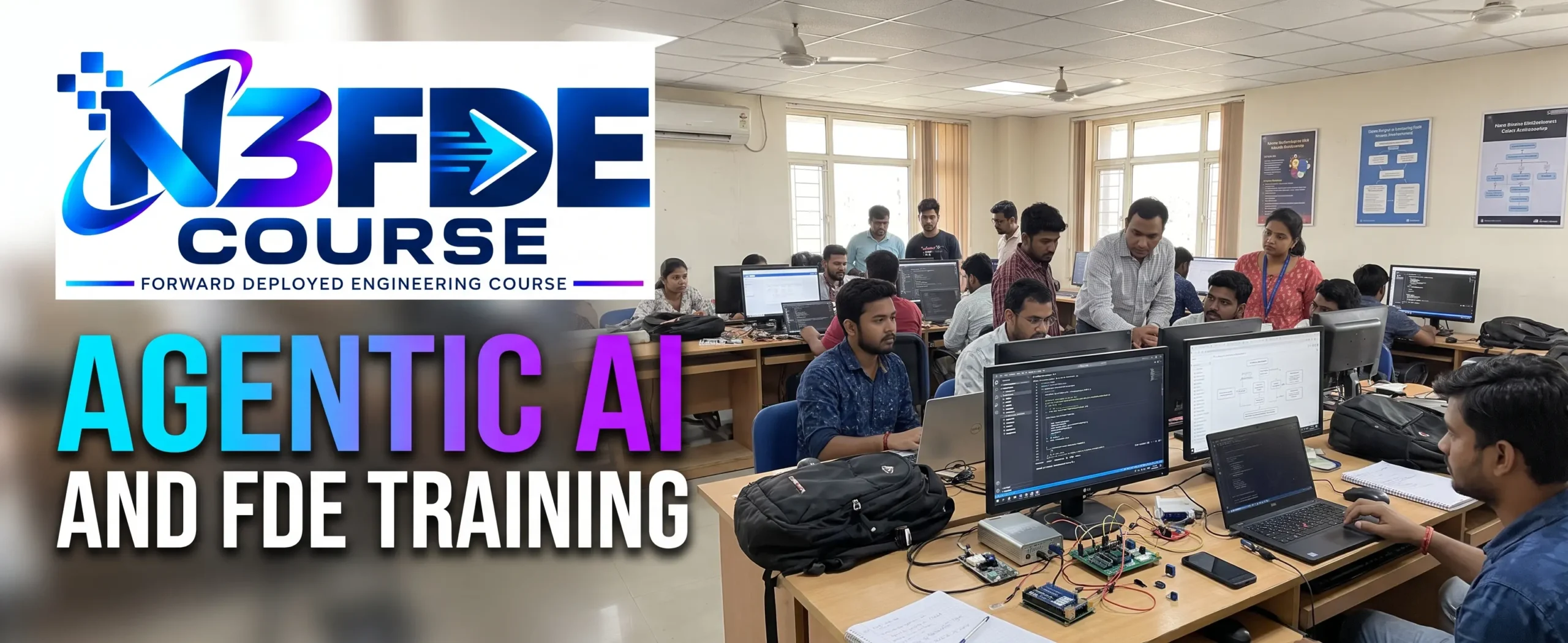
Agents, Tools & Flows
As soon as you go onsite, you realise a hard truth. Having an LLM which can’t perform actions in the real world is not useful. Consequently, our curriculum focuses on teaching you how to create controllable systems from passive models.
Autonomous Agents & State
An Agent is normally a system that can reason about how to solve a problem. Moreover, it can plan steps and remember previous actions. During your training, you will learn how to manage short term conversation state and long term database state. Therefore, your agents will be able to complete complex business tasks.
Using Secure Tools & APIs
Agents need to be able to do something. First, you will create secure JSON schemas and Python Wrappers. These allow your agents to query SQL databases, view internal Jira tickets, and invoke REST Endpoints. In addition, trainees will learn how to use external tools using the Model Context Protocol and function calling. Finally, you will also learn how to create secure boundaries so your agent never deletes something it shouldn’t. After all, FDEs will be deploying in high security environments.
Deterministic & Multi Agents
You will add checkpoints so a client manager can approve risky actions. For example, this includes issuing refunds or updating production records. Furthermore, developers will create Supervisor/Worker systems, where a Router Agent can pass tasks onto specialised sub agents. Usually, tooling can cause chaos and hallucinations. Instead, we will teach you how to split complex business tasks into structured workflows using LangGraph.
Practical Tasks
If a client’s production server crashes during a demo, you won’t be able to use slides to get out of it. Because of this, the training focuses on practical tasks.
-
Legacy ERP Triage System: Instructors will place you into an environment simulating a corporate setup with a messy SQL database and a clunky REST API. Subsequently, you will have 48hrs to create a tool calling agent. It must read customer emails, check inventory levels, and produce an accurate order update.
-
Infinite Loop Rescue: Often, agents can get stuck in loops of using a faulty tool. Consequently, this causes thousands of dollars of API tokens to be wasted. Using trace logs, you will investigate the logical error. Then, you will create a circuit breaker to stop the agent using too many tokens. We provided a runaway multi agent process.
-
Red Teaming & Guardrail Injection: As a result, you will create secure input and output validations to fix the issues you found. Specifically, you will pair up with another trainee. Together, you will attempt to trick their agent into revealing sensitive database credentials or calling something it shouldn’t.
-
Live Stakeholder Scope: In this activity, the instructor will play a panicking non technical VP. Specifically, they want an autonomous agent to automate their entire supply chain by Friday. Therefore, you will have to analyse their messy data and be polite when pushing back on unreasonable requests. Ultimately, you must scope out a safe minimum viable workflow which you can deliver on time.
Why this is Important
By knowing how to create agentic systems and deploy them, you become the exact engineer companies need. As a result, you can help them achieve their AI ambitions. Conversely, AI Researchers who only know about model weights will panic when they hit issues with faulty business networking. Similarly, Software Engineers who only know how to create normal backend code will struggle with unpredictable models.
N3 FDE Course
Flat 515, Fifth Floor,
Annapurna Block,
ADITYA ENCLAVE,
Kumar Basti, Ameerpet,
Hyderabad, Telangana,
500038, India
Phone: 9032102017