
Forward Deployed Engineer vs Machine Learning Engineer
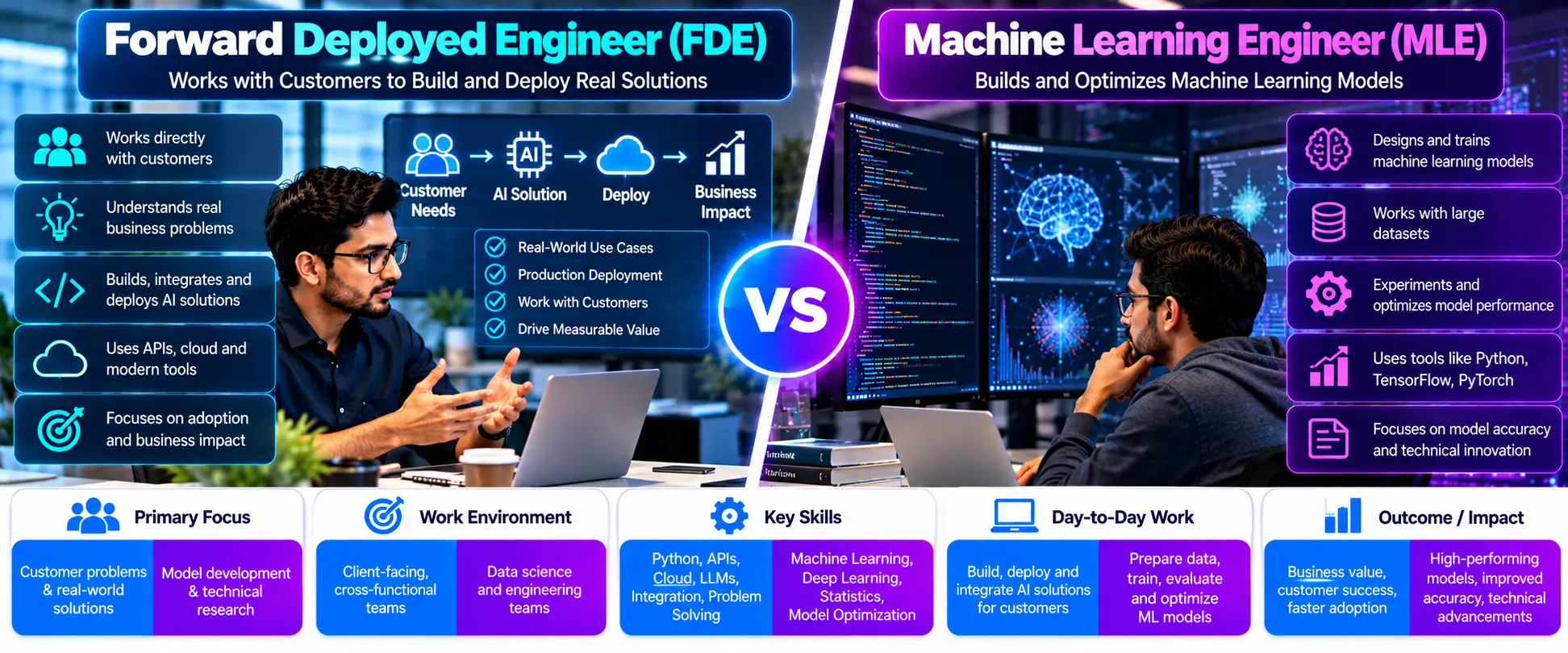
Both of these careers are closely related to the fields of AI. However, the roles of a machine learning engineer and a forward deployed engineer are different. A machine learning engineer creates the product, while a forward deployed engineer brings it to clients and makes it applicable to their needs. This guide discusses the main differences and similarities between the two, including skills, a day in the life of an employee, and career growth and opportunities.
Forward Deployed Engineer
A forward deployed engineer (FDE) writes code, but they are not tied to the screen. These specialists interact with customers and learn about their operations, studying the product’s unique requirements and goals.
Their work is versatile. An FDE is capable of performing all tasks related to the creation of the product. While one day they can spend connecting a client’s CRM to AI, the next, they will build pipelines and deploy products to production. Moreover, FDEs are the first to be contacted when a problem occurs, which is why they need to be multi-skilled and quick to find solutions. Thus, the role of a forward deployed engineer combines three elements: engineering, customer care, and product development. This career requires the ability to explain things simply and to solve problems.
In addition, few fields are as multifaceted and diverse as an FDE’s career. Specialists in this niche can work in various industries, from logistics and fintech to retail and media.
Machine Learning Engineer
A machine learning engineer (MLE) is a professional who trains models on datasets and determines their quality. These engineers optimize their performance to obtain accurate results.
An MLE’s job is highly dependent on artificial intelligence. Most often, such specialists work within a product team, interacting with data scientists and software engineers. The end-users of their product are typically unknown to them. In addition, MLEs spend much of their time working on the backend, creating algorithms and improving existing ones. The primary responsibilities of an MLE include building and training models, conducting experiments, organizing and tracking data, and deploying software into production.
Key Differences Between Forward Deployed And Machine Learning Engineers
Below are some of the main differences between forward deployed and machine learning engineers.
Forward Deployed Engineer Machine Learning Engineer
Focus Bringing the product to users Improving models
Customer Interaction High Low
Scope Broad Narrow
Success Metric User satisfaction Model accuracy
Pacing Variable Steady
Career Differences And Similarities
There are few similarities between the two careers, although some are present. For example, an FDE and an MLE have a solid understanding of Python. Moreover, both areas of work are in great demand and offer excellent career advancement opportunities.
However, the two careers differ significantly in terms of responsibilities, skills, and required experience. An FDE has the responsibility of an all-around problem solver, while an MLE is focused more narrowly on training and improving AI models. In terms of skills, FDEs need a broader knowledge of programming, while MLEs have a solid understanding of statistics and linear algebra.
A Day In The Life Of A Forward Deployed Engineer
The daily tasks of an FDE are constantly changing and depend on the current needs of the customer. For example, on Monday, an FDE can spend the morning analyzing a client’s operations to identify a suitable use case. After that, they can proceed to design a prototype by lunch. On Tuesday, they may need to debug an API to find out what exactly went wrong and demonstrate the solution to the client.
A Day In The Life Of A Machine Learning Engineer
An MLE’s work is more predictable and calmer than that of an FDE. First, an MLE reviews the results of the experiments performed overnight. Then, they make some changes to hyperparameters or features and repeat the experiments. Moreover, during the day, an MLE can work on documentation or planning and design new architecture.
Comparing the daily activities of the two engineers, it becomes evident that they have little in common. The two engineers solve different problems: an FDE addresses users’ issues, and an MLE focuses on product-related aspects.
Careers Growth And Opportunities
FDEs and MLEs are both in demand, and companies are actively looking for specialists in these fields. In addition, the need for AI products is continuous, as such technology can benefit almost any business. There are many ways to grow within the FDE career since it covers multiple industries. For example, one can move from an FDE to a solutions architect, technical lead, or product owner. In addition, there is an opportunity to become a consultant or work for a startup.
As for MLEs, one can advance to such positions as senior machine learning engineer, research engineer, or ML architect. Moreover, there is an opportunity to move into leadership roles, such as leading an AI platform team. Salaries for both careers are high, although they may vary depending on the region, company, and experience. It is essential to research the current trends in the area to determine the expected income.
Which Career Should You Choose?
When choosing a career, one should consider what excites and motivates them. For example, if one prefers to communicate with people and solve their problems, then the FDE career may be a good choice. If someone likes logic and math, an MLE career may be more interesting to them. In addition, if someone is a software developer, it may be easier for them to transition to the FDE career. Those who have a degree in statistics or data science may have a better foundation for an MLE career. However, in most cases, the choice of a career should be made individually, based on one’s preferences.
How To Get Started With Your Career
To prepare for an FDE career, one should learn Python and APIs, gain experience working with cloud technologies, and learn to apply knowledge in practice. Moreover, it is essential to become familiar with such languages and methods as large language models, RAGs, and agents.
The preparation for an MLE career involves learning Python, studying linear algebra, and acquiring basic skills in statistics. Additionally, one must learn the fundamental concepts of ML and be familiar with such technologies as PyTorch and TensorFlow. Moreover, anyone who wants to adopt the MLE career path should have experience working with data in practice.
A practical approach to preparing for either career is to begin with small steps, practice regularly, and gain practical experience. Moreover, it may be helpful to enroll in a program that has a proven curriculum, provides mentorship, and prepares one for interviews. However, it is essential to avoid institutions that offer theoretical information without any practical skills training.
Final Thoughts
Both of these careers are beneficial and exciting, and they shape the future. While the MLE career is concerned with creating and optimizing artificial intelligence, the FDE career focuses on adopting it in various spheres of human activity. Thus, anyone interested in artificial intelligence and ready to learn can make the right choice in favor of one of these two exciting careers.