
Dumping an entire unparsed PDF into an OpenAI API call is a neat demonstration, but an enterprise client with a properly configured air-gapped infrastructure will laugh at you at the first sprint review
The RAG tutorial makes everything look simple on a happy path, but in practice, you need to write dozens of customized OCR extraction rules, hybrid dense/sparse vector pipelines, and cross-encoder rerankers, while ensuring that your private models running on a customer’s Kubernetes cluster never see any external API.
Through our practical Forward Deployed Engineer course, we skip the theoretical fluff and equip engineers with real-world production retrieval toolsets that can handle RBAC security constraints and non-standard document parsing requirements. Our mentors are hands-on FDE professionals who can show you how to build a reliable retrieval augmented generation system from scratch without relying on any third-party APIs
Call us at 9032102017 to get a syllabus or enroll in the next cohort!
Production Retrieval Stack for Enterprise FDEs
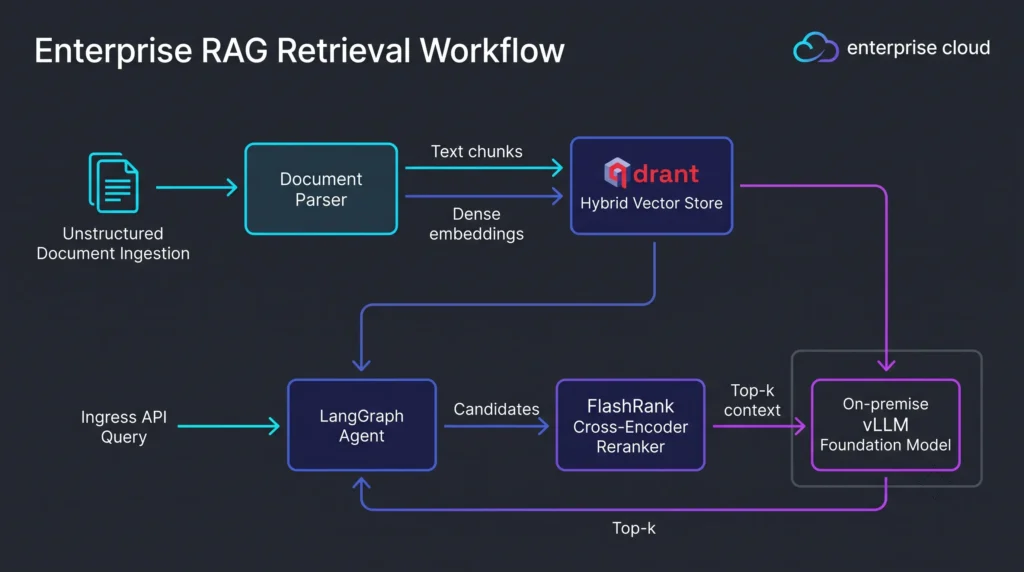
Ingestion and Document Parsing: LlamaIndex and Unstructured
If your document extraction layer fails on the first stage, the rest of your RAG pipeline will produce garbage:
-
LlamaIndex: The library of choice for creating hierarchical indexing structures with parent/child chunk relationships. Whenever your application queries an isolated clause, you will need context from higher-level nodes to produce a coherent answer.
-
Unstructured.io: Parse files in formats that standard Python libraries cannot handle. Use the package to extract text, tables, and images from PDFs, Word documents, and PowerPoint slideshows.
-
Docling: A newer document parsing library designed to preserve complex formatting. Extract tables with merged cells as markdown to maintain their structure in LLM prompts.
Orchestration and Agentic Routing: LangChain, LangGraph, and AutoGen
Vanilla RAG chains are useful while your enterprise customers ask simple factual questions, but the moment there is a need to compare values across three different rows, you will have to reimplement your entire pipeline:
-
LangGraph: This task automation framework is perfect for implementing complex routing logic, retries, and human approvals in domain-specific RAG applications. Use the library to convert your monolithic RAG chain into a state machine with defined entry/exit nodes for agents.
-
LangChain Core: Leverage the LCEL expression language to define reusable components for prompt engineering, schema validation, and model serving.
-
DSPy: Stop fiddling with prompt engineering parameters for every model update. Define your prompts as DSP programs and let the library optimize few-shot examples and instruction tuning automatically.
Vector Databases and Hybrid Retrieval: Qdrant, Chroma, and pgvector
Exact string matching is a rare occurrence in enterprise data lakes, so your solution needs to implement hybrid similarity search for both dense and sparse vectors:
-
Qdrant: A high-performance vector database with native support for filtering by payload fields. Use the Rust-based engine to implement fine-grained access control and RBAC at the query level.
-
pgvector: If a customer’s security department forbids installing any new databases, keep your hybrid retrieval layer inside their PostgreSQL instance.
-
FlashRank & Cohere Rerank: Avoid wasting compute budget on irrelevant database entries by implementing a cross-encoder reranker. Limit the number of retrieved documents to four most relevant passages to reduce inference cost per query.
Evaluation, Guardrails, and Observability: Ragas, TruLens, and NeMo
Enterprise RAG applications need quantitative evaluation to justify the annual budget to executives:
-
Ragas: Evaluate the performance of your RAG system with industry-standard benchmarks and obtain concrete numbers for faithfulness, answerability, and context precision.
-
NeMo Guardrails: Protect your production endpoints from adversarial prompt injections and ensure that the model output conforms to the expected response schema.
-
Phoenix (Arize) & TruLens: Monitor your RAG application with distributed tracing and debug hallucinations by inspecting the retrieval context at query time.
Why N3 FDE Course in Hyderabad?
Watching others debug an out-of-memory error on the customer’s server is not the same as fixing production issues yourself while racing against a deployment deadline
-
Four Complete Production Capstones: Build and optimize a RAG pipeline, fine-tune a reranking model, and set up observability tools in your GitHub portfolio to demonstrate real-world skills.
-
Mentors Who Actually Ship: Learn from instructors who spend their time contributing to open-source retrieval projects and advising Fortune 500 companies on MLOps best practices.
-
Practical Interview Prep: Prepare for technical screenings by practicing whiteboard exercises, vector pipeline troubleshooting, and client architecture walkthroughs.
-
Direct Admissions Line: Schedule a consultation to discuss your background and arrange a tour of our training facility. Call us at 9032102017
N3 FDE Training
Flat 515, Fifth Floor, Annapurna Block,
ADITYA ENCLAVE, Kumar Basti, Ameerpet,
Hyderabad, Telangana 500016, India
 Phone: 9032102017