
Introduction
FDE and generative AI are becoming closely linked. Enterprises want chat bots, copilots, agents, and similar systems. Few companies however actually understand how to develop these systems within their own business.
These are exactly the opportunities that Forward Deployed Engineers (FDE) can utilize. They transform generative AI from an exciting technological novelty into a deeply integrated and productive tool for the enterprise user. This article covers what skills FDEs offer, provides some insight into required skills, and shares some useful recommendations.
What is Generative AI?
We’ll start with a review of what generative AI is. The technology enables models to generate new text including computer code, summarize large bodies of text, and answer questions (among other operations). Many current systems use large language models (LLMs).
What is a FDE?
A FDE (Forward Deployed Engineer) is a customer-facing software engineer. They perform a systems-design role, determining how the product will serve the user’s needs. Some FDEs work at the customer’s location while others work remotely communicating frequently with the client. The role was pioneered by Palantir but is now found in various AI companies and consultancies.
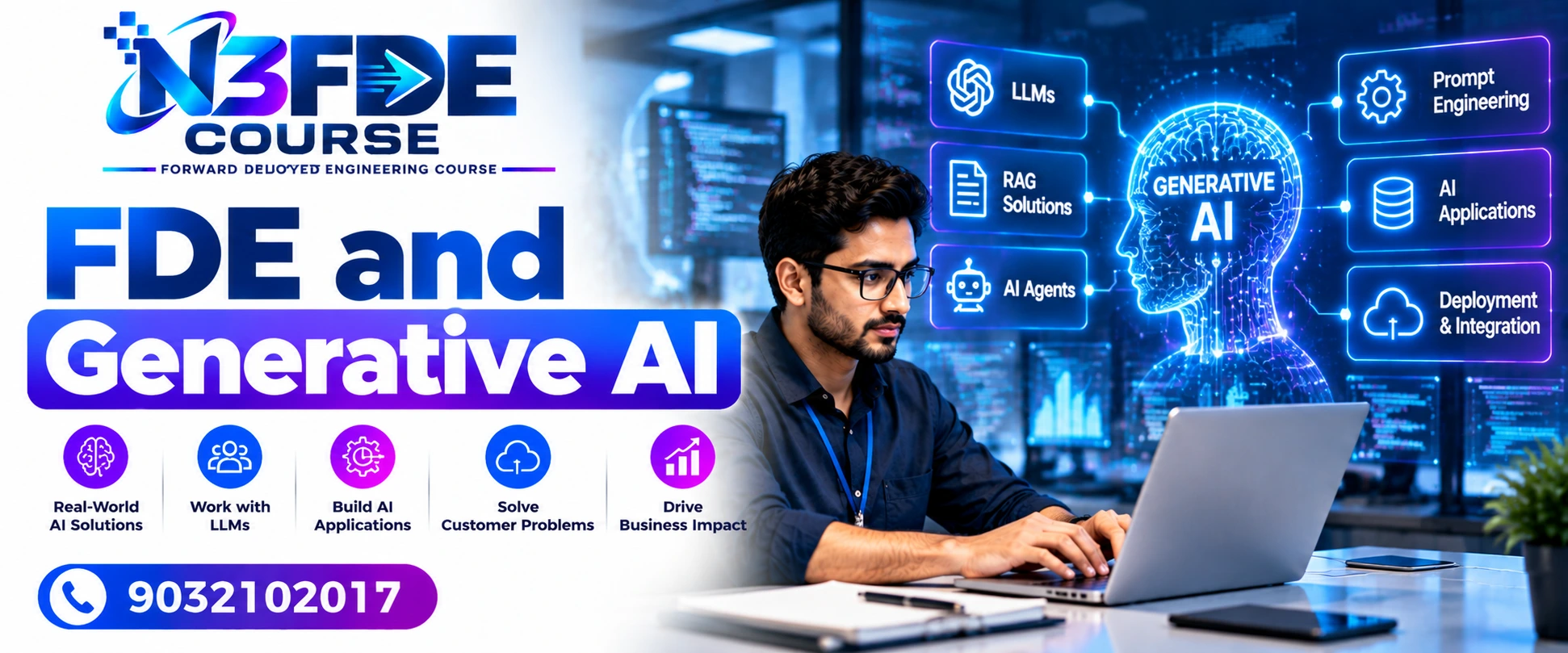
FDE and Generative AI: Synergy
On the surface, generative AI appears easy to implement. Ask a question, get an answer. But inside a company, challenges arise immediately. Information is located in various enterprise databases and is often confidential or otherwise protected. Company personnel need to be trained to receive and act upon the information retrieved. Supervisors need convincing that the system delivers benefits. Model errors are costly.
FDEs tackle all of these problems, connecting the enterprise and generative AI models in a productive and lasting partnership. Their support increases production-ready deployments dramatically. Let’s discuss this further.
What do FDEs Do with Generative AI
FDEs perform a variety of tasks in implementing generative AI at the enterprise.
FDEs Build Retrieval Systems To Bring In Company Data
Most models are trained on generic information that isn’t available to enterprises. FDEs solve this issue by building retrieval systems that allow the model to access company-specific documents. This critical step is sometimes referred to as “retrieval augmented generation” or RAG. With such a system, the model combines generic knowledge with the confidential, sensitive, or otherwise unavailable information specific to the company.
FDEs Design Prompts and Optimize Models
A properly-worded prompt can dramatically improve results from the same base language model. FDEs perform extensive testing and optimization to ensure the prompts are producing the best possible outcomes. Similarly, the FDEs perform model fine-tuning if the system needs domain-specific capabilities.
FDEs Design Evaluations to Ensure Accuracy, Safety, Tone, and More
Every enterprise deploying models needs a verification process. FDEs develop such tests to confirm the system performs as desired. They also routinely check the model for undesirable outputs and correct them as needed.
FDEs Develop AI Agents
In some cases, the AI system must execute instructions or respond to events. These capabilities are implemented as agents by the FDEs who also configure safeguards as needed. The agents might schedule meetings or update records when specific triggers are detected. By default, however, such measures are unavailable to enterprises and must be specially configured by FDEs.
FDEs Train End-User Communities
Finally, the FDE trains the users to interact with the new system. They also serve as liaisons to the public facing community, ensuring a steady stream of feedback and iterative improvement of the system.
A Simple Example of FDE Implementation
Suppose there is a bank that wants an AI assistant that provides support to its own service desk. The AI must be able to answer questions according to the bank’s own policy documentation. Here’s what the FDE would do:
The FDE would first meet with the service desk staff to understand their needs and prepare requirements. Next, they’d configure the system to retrieve the relevant policy documents and test responses to user questions. Any inaccuracies, policy violations, or other issues would be addressed. Particular attention would be paid to preventing the system from revealing documents that shouldn’t be shared.
As a result, the bank’s service desk gets a functioning AI assistant. This is the FDE’s work, while the underlying model was provided by the vendor.
Overview of Required Skills for FDE Positions
For the FDE specialty, employers tend to seek similar skills, which can be grouped into two large clusters.
Technical Skills
Languages: Python, TypeScript, SQL
Api’s, data pipelines, cloud platforms: AWS, Azure, Google Cloud
LLMs: prompting, retrieval, agents
Evaluations, testing, etc.
Human Skills
Communication: non-technical audience
Problem-solving: ability to deal with ambiguous, ill-defined problems
Ownership
Learning: how fast can you learn a given industry?
Two key skillsets needed: technical and human. Technical skills allow FDEs to perform their daily activities, while human skills determine how effective they can be. An excellent coder who cannot communicate is unlikely to be very successful. At the same time, a superb communicator without technical skills will not achieve much. For these reasons, both areas are important.
Why These Positions Are In Such Demand
FDE roles are in high demand for several reasons. Enterprises want generative AI, but they lack experienced personnel. Customers now expect FDE support as an inherent part of any enterprise-level implementation. Product teams need input from FDEs in the form of feedback from real-world usage. Finally, privacy, security, compliance, and similar concerns are especially important in the enterprise space.
These are the factors behind the strong demand for FDEs.
The Future Outlook for FDE Careers
FDEs can pursue multiple different career tracks. They can transition into product management, leadership positions within the core engineering team, or become independent consultants. Some FDEs even start their own AI consultancies. In all cases, these specialists benefit from their front-line experience with the customer.
How You Can Prepare for a Career as an FDE
To prepare for an FDE, there are several key recommendations.
1. Know Python and SQL well.
2. Learn the theory, inner workings, and prompting techniques of large language models.
3. Develop at least one RAG prototype and test it on your own data.
4. Develop at least one AI agent – something simple that would allow you to perform a given task.
5. Practice explaining things clearly and simply. Avoid unnecessary jargon.
6. Choose a domain of interest (medicine, banking, etc.) and learn the basics of that industry.
7. Attend training, take courses, participate in camps.
Most importantly, aim to develop working examples. Employers are much more impressed with concrete working experience than with long lists of theoretical coursework.
Summary
The synergies between FDEs and generative AI are driving significant changes in numerous industries. AI models continue to evolve and improve. However, no matter how sophisticated the technology becomes, enterprises will always require competent people who can implement new solutions, optimize their performance, maximize value, and minimize risks.
By focusing on these capabilities, FDEs fill a critical need. This is a challenging and rewarding role that offers diverse opportunities for advancement. If this sounds interesting to you, start preparing for this career track today.