
Introduction
The Forward Deployed Engineer (FDE) role in AI engineering has seen a rapid growth in the last several years. Top companies like OpenAI, Anthropic, and Databricks have seen a significant increase in FDEs on their staff. Numerous startups have also followed the trend.
But why this sudden interest in this specific AI engineering role? Why can’t regular engineers handle the task of deploying AI models in production systems?
The Role Of The FDE In AI Engineering
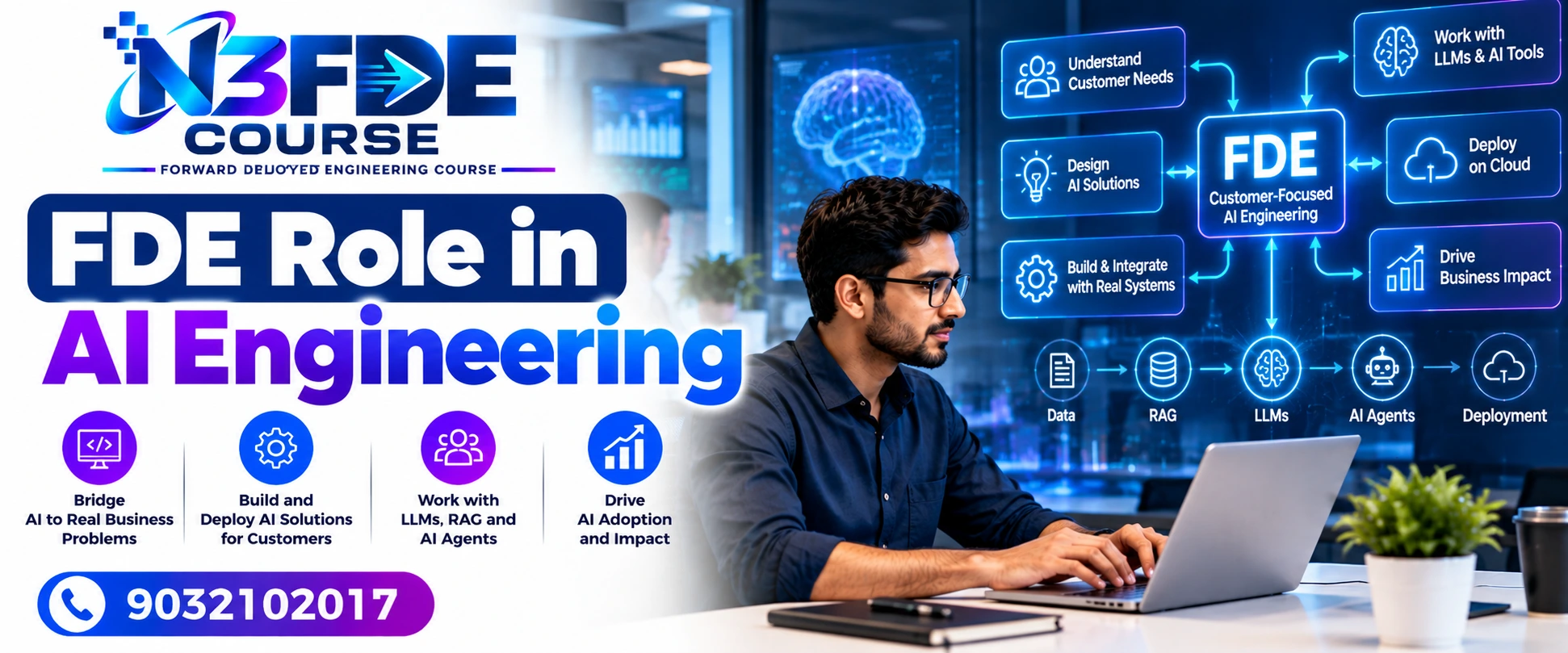
The Forward-Deployed Engineer (FDE) is a software engineer who works directly with clients to develop solutions for their needs. Some FDEs work on company premises while others work remotely but stay closely connected to the client. FDEs develop solutions that fit their needs.
An FDE in AI engineering specializes in deploying AI models into production. They also build systems around them, such as a support chatbot or a search engine for documents.
An FDE is neither an academic researcher nor a technical support engineer. Usually, they don’t develop novel models, and they don’t handle day-to-day operations questions. Instead, they occupy a grey space between researchers and technical engineers. They focus on deploying production-ready solutions and actively communicate with the client.
The Need For FDE In AI Engineering
The typical AI demo is impressive. Most businesses, however, have legacy systems and data warehouses. These make it extremely challenging to integrate an AI system. Many companies also have privacy and security issues, which complicates matters further. Thus, numerous AI pilots fail to transition from a demonstrator to a production-ready system. No one was responsible for this “uninteresting” stage of deployment. The FDE tackles this issue by integrating the AI model into the company’s data infrastructure. They also make the necessary adjustments and prove that such a system is valuable to their operations. This allows for much faster AI implementation.
A Day In The Life Of An FDE
An FDE typically doesn’t have a single task throughout the day. However, most of their work involves the following:
- Communication with the client
- Building an integration with the model
- Building retrieval systems (enabling the model to access the company’s data)
- Prompt engineering and tuning
- Evaluation and testing procedures
- Building and integrating AI agents (software agents)
- Training the client’s staff
- Reporting back to the product team
An FDE may have a meeting with the client on Monday and build a prototype by Wednesday. By Friday, they may demonstrate it to the client and receive feedback. Thus, they often have an extremely fast iteration cycle.
FDE vs. The Traditional AI Engineer Role
An AI engineer and an FDE have a lot in common. However, the two roles differ in the following ways:
Unlike the traditional AI engineering role, an FDE spends the majority of their time on “customers’ problems.” An FDE deploys models in production environments while traditional AI engineers focus on general-purpose solutions that a wide audience uses.
An FDE role is similar to the traditional product engineering role. While a traditional AI engineer builds products, the FDE focuses on delivery. An FDE also interacts with clients directly and has to address their unique problems. Whereas, an AI engineer builds more generalized products that require extensive prompting and curation to achieve satisfactory results.
FDE Skill Set
An FDE requires a blend of technical and non-technical skills. Technical skills include:
- Python, TypeScript, and SQL
- Designing and implementing application programming interfaces
- Cloud computing
- Experience with LLMs: prompting, retrieval, agents
- Evaluation and testing
The required non-technical skills are:
- Communication skills: ability to explain complex concepts to non-experts
- Interpersonal skills: dealing with ambiguity and frustration
- Customer focus: taking ownership of the problem and finding a solution
- Fast learner
The blend is necessary because an FDE serves as the liaison between the technical and non-technical sides of the business. An expert coder who lacks communication skills would be a poor fit for this role. Likewise, a technologically savvy person who struggles to explain things to others would not be a good match either.
An Example Scenario
Suppose a hospital wants an AI system that can summarize patient notes. Developers could build such a model fairly easily. That is because the language modeling community has reached a point where LLMs can perform many tasks, including summarization. However, the hospital has unique requirements: all patient data must stay private and secure. Thus, the hospital would need an FDE to tweak the model and integrate it with the existing hospital database. The FDE would also confirm that the system works correctly by doing test runs and receiving feedback from medical staff. In this example, the FDE made the system useful, even though the model itself didn’t change significantly. They were able to do so by understanding the hospital’s unique requirements.
Why Is There A Sudden Demand For The FDE?
There are several reasons for that, but we’ll only discuss the three major ones. First, AI adoption is growing. More companies are looking to utilize AI in their operations, but most of them don’t know how. Second, enterprise sales usually require a heavy focus on the client, so each case needs its own AI engineering. Finally, the FDE is the liaison between the client and product teams. This puts them in the best position to suggest improvements to the product. These three reasons explain the current demand for FDEs. As the trend gains momentum, it will create new job opportunities. So it might be a good idea to consider this career path.
Exploring The FDE Role Pathways
Most roles will require you to become a product manager or engineering leader after some time, or become a consultant. If you have sufficient talent and experience, you may even found your own startup. There are a number of possibilities from here. You don’t necessarily have to become an FDE for the rest of your career.
How To Enter The FDE Role
To get started in this role, it’s a good idea to have fundamental Python skills and SQL skills. It’s also essential to understand why and how LLMs work. So you may want to take courses or follow tutorials on this subject. After that, it’s a good idea to start building AI applications, focusing on the prompt engineering, retrieval, and evaluation. Finally, you may want to increase your verbal communication skills. It also helps to learn more about one specific industry, such as healthcare or finance. You should also consider getting training in this new field. The best way to start is to go to an online training or university, and get experience through your projects. All in all, building some relevant projects would be much more important than taking tons of courses.
A Final Word
An FDE in AI engineering is a unique and rapidly growing role. It sits at the intersection between computer science and business. The role has been growing at a rapid pace recently, due to increased focus on AI adoption in enterprises. This trend will continue for the foreseeable future, and these professionals will be in demand for the next several years. If you enjoy programming and want to work in AI but don’t have a CS degree, this could be a perfect fit. The same applies if you are a CS graduate looking to switch to AI engineering. Either way, it is a great way to start your journey in AI engineering.