
Introduction
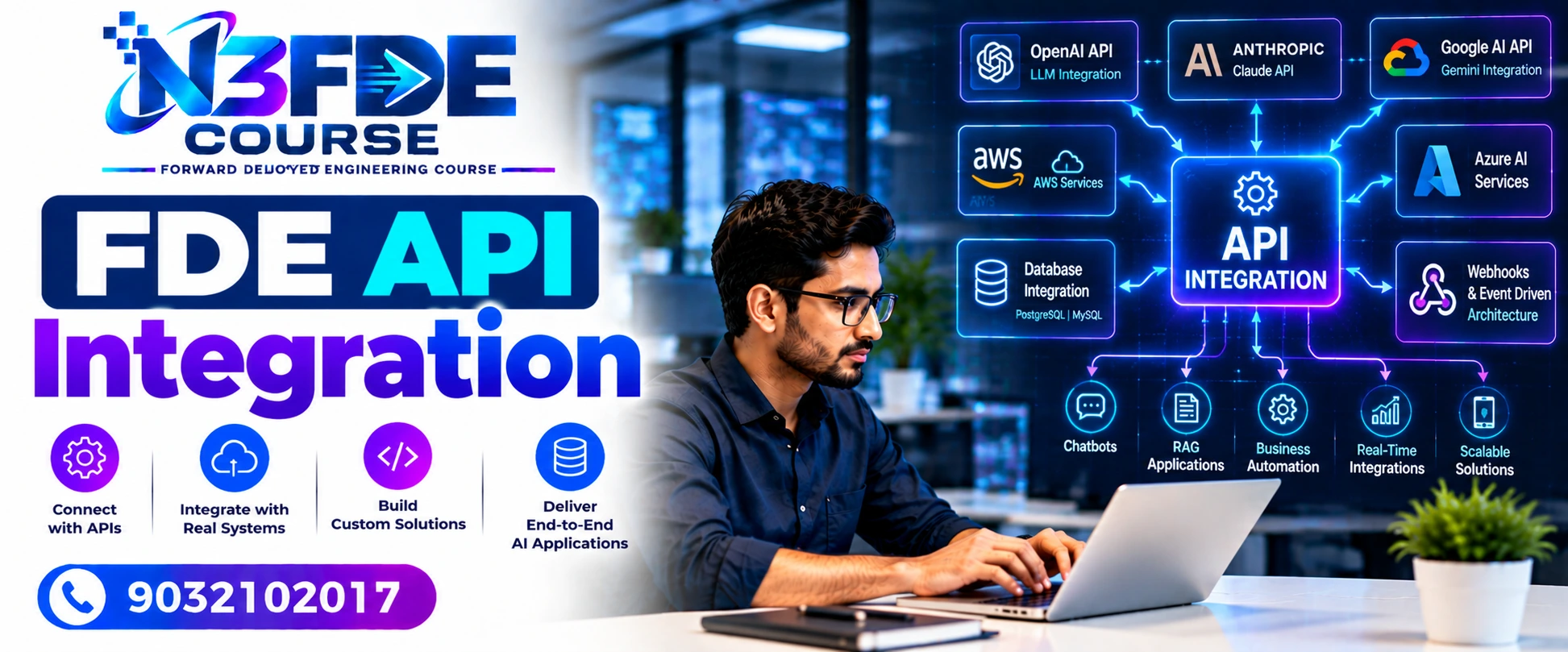
FDE API integration is a cornerstone of the job, as most tools are not inherently interoperable and require integration to be useful. The task of integrating these systems usually falls to a Forward Deployed Engineer.
In this article, you will learn what is API integration, how FDEs perform it, and what skills are needed to excel at it.
What Is API Integration?
An API, or application programming interface, is a set of rules and tools that allow two software systems to communicate with each other. Like a waiter in a restaurant, an API can be used to relay information from one party to another. For instance, a customer can send an order to the kitchen via the waiter, and the kitchen will prepare the requested dish and bring it to the customer.
An API integration, then, is a process of linking two or more systems together using their APIs. For example, a support desk software can be integrated with a customer relationship management tool to relay customer data or an AI model can be integrated with a shared file system to read documents. Through an API, data, instructions, and information can be exchanged between systems without requiring any human interaction.
What Is a Forward Deployed Engineer?
A Forward Deployed Engineer (FDE) is a type of software developer who works closely with a client to understand their needs and create a software solution. Some FDEs work on-site with their clients while others may work remotely but still maintain a close and personal relationship with them. The practice of FDEs began at the company Palantir, but other AI and Software Development companies have begun to adopt similar roles.
Why API Integration Is Central to the FDE Role
While a great product is important, it must also be able to reach the consumers that need it. Many organizations use dozens of different software products to carry out their operations. These can include traditional legacy systems as well as cutting-edge software. Each one possesses some unique portion of the total information required by an organization. An FDE must be able to integrate their company’s product into the existing systems of the client. This ensures said client can use their new product with their existing and familiar tools.
How FDEs Handle API Integration
Most FDE projects have six major steps.
Learning the Systems
An FDE must have a deep understanding of what tools are being used by their client. This helps them determine what data they must extract or use from the system. During this step, FDEs must also identify which organization owns which systems.
Studying the Documentation
FDEs spend this step poring over the information provided by the APIs’ documentation. This can show them what data the system provides, accepts, and can process. If the documentation is lacking, the best FDEs can do is test all the possible endpoints and log their results.
Authentication
Most APIs utilize some method of the authentication to prevent unauthorized users from accessing their data. The FDE must install authentication tools such as API keys, OAuth, and tokens. They must also protect and store sensitive information from unauthorized access. Finally, the FDE must ensure each integration only accesses the data that it needs.
Moving and Transforming the Data
Many systems cannot directly communicate with other systems due to each having their own unique format and standards. During this step, the FDE must write specialized programs that can convert data between different formats. For instance, the FDE may need to write programs that will change dates from 02/10/2026 to 2026-02-10. The FDE must also ensure the data is clean and valid during the process.
Error Handling and Rate Limiting
The FDE must also create specialized error handling code to ensure the two systems can communicate even through issues occur. The FDEs should also account for the fact that API servers and services may be unavailable or slow at times and code in wait time between requests. Rate-limiting is also important for ensuring the applications don’t send too many requests and get permanently blocked.
Monitoring and Maintaining
The work of an FDE is not done once the product has been launched. APIs and their internal systems are constantly updated and changed. To combat this, FDEs must set up monitoring and alert systems so they can be notified when an issue occurs. The FDEs must also make updates to their code if a system they rely on is updated.
A Simple Example
A retail company wishes to improve their customer support by giving their agents an AI assistant. The AI is intended to help customer agents retrieve data about a given order. The AI must also be able to provide information about shipping and returns. The data about an order is held in a special system, while the shipping and return info is held in other systems. An FDE begins their task by meeting with the customer agents to discover their needs. They then begin to integrate their AI application into the three systems. They finally test their application to ensure it meets the requirements. With this application, customer agents can now access all the information they need in one place. As a consequence, the customers receive better and more accurate information.
Common API Integration Challenges
Poor Documentation: When documentation is lacking, FDEs must test and probe the API to find what they need.
Legacy Software: Some systems do not have APIs and must be accessed using other means.
Security: Many systems restrict access to data for security reasons.
Rate Limiting: Systems often only allow a certain amount of API requests per minute.
Changing APIs: APIs are often updated and require FDEs to update their code.
Skills for FDE API Integration Work
Many companies are looking for FDEs that possess a blend of technical and soft skills.Technical Skills Python, TypeScript, and SQL REST and GraphQL JSON, webhooks, and common data formats Authentication methods such as OAuth and tokens Data pipelines and cloud technologies Testing and Debugging tools such as Postman People Skills
Communication with non-technical staff
Patience and flexibility in the face of strange systems
Ownership and determination to succeed
The ability to learn new concepts quickly
Both these skill sets are important; a quick but ineffective coder who does not care about their results will probably not succeed. However, a skilled but careless developer can be just as damaging to an FDE project.
Why Demand Is Growing
There are several major factors that have increased the demand for FDEs. First, companies are increasingly using more software products that must communicate with each other. Second, products, particularly AI programs, must access company data to be useful.
Finally, customers are demanding more rapid and direct support. The combination of these forces has resulted in many companies seeking the talents of FDEs.
Career Growth for FDEs
This job offers many opportunities for growth. Some FDEs grow into leadership positions and begin managing teams of developers. Other FDEs go on to become Product Managers or Solutions Consultants. Finally, some FDEs branch out on their own and start their own businesses. Experience as an FDE can serve as excellent preparation for many careers in tech.
How to Start Your Journey
Anyone can begin their journey towards becoming an FDE.
Learn Python and SQL.
Learn about REST APIs and their request/response format.
Test your knowledge by building small applications with public APIs.
Build your first application that utilizes two different APIs.
Add error handling and logging features to your application.
Learn about methods of authentication such as OAuth.
Attend a hands-on training course.
Projects are the most important part of your portfolio, so you should strive to build a few applications.
Final Thoughts
FDE API integrations allow companies to transform disparate sets of tools into a united and effective system. While many products are becoming more intelligent, they still require FDEs to reach into company systems and retrieve the information they need. If you want to become an FDE, these suggestions should serve as a strong starting point. There are many exciting opportunities ahead, so you should begin preparing yourself.