
Introduction
FDE cloud deployment is the meeting place of good ideas and reality. A nice prototype on a laptop looks great, but to satisfy a customer it needs to be safely hosted and ready for anyone to use.
Forward Deployed Engineers do exactly that: this article explains how they deploy software and AI on the cloud, and how you can become one of them.
What Is Cloud Deployment?
Cloud deployment implies hosting software solution on servers provided by a third party. AWS, Microsoft Azure, and Google Cloud are the largest providers, but there are many more. Companies choose cloud hosting to avoid large upfront investments and pay only for the resources used.
In other words, cloud deployment is the process of preparing, packaging, shipping, and managing a hosted software solution. This implies servers hosting, storage, access control, and many other technical means.
What Is a Forward Deployed Engineer?
A Forward Deployed Engineer is a software engineer who creates a solution for an actual customer. First, they examine a current problem and come up with a fitting technology stack. While some FDEs work on-site, others provide their expertise remotely.
The FDE concept was originally developed by Palantir, but now there are many companies specializing in AI-powered solutions. As a result, such organizations have a demand for FDEs who understand cloud deployment.
Why Cloud Deployment Matters in the FDE Role
Besides developing a solution, FDEs are responsible for its successful launch. They should be able to host their software on-premise or in a customer’s private cloud.
There are different approaches to deployment, and FDEs should know which method suits a particular project. Some customers may require full control over the infrastructure, and others – delegate all responsibilities to the FDE. In addition, there are many more conditions to take into consideration.
FDEs also affect the technical design of a software solution, depending on the deployment environment. For example, there are certain rules for storing health data or financial information. Similarly, a private cloud may have limited bandwidth, and an on-premise server might lack support. Therefore, an FDE should know all these conditions and provide a working solution.
How FDEs Handle Cloud Deployment
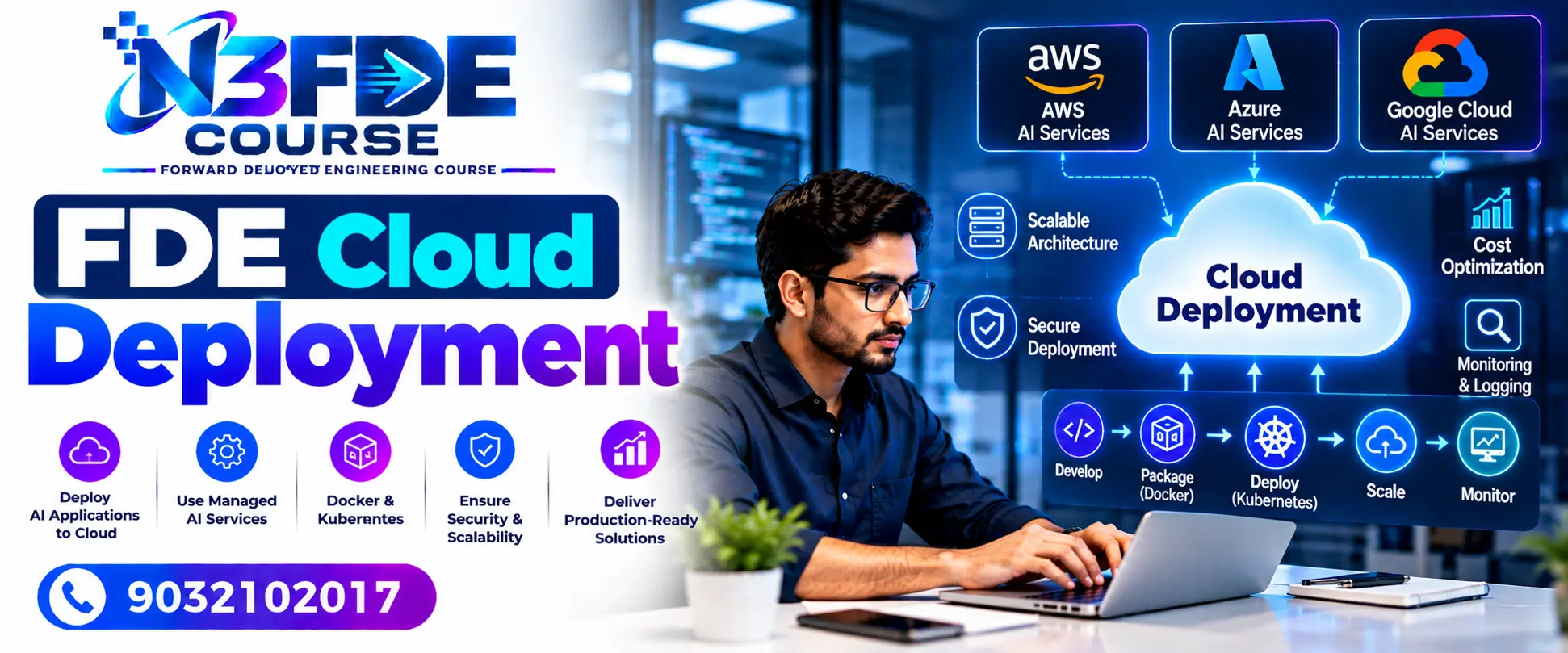
There are usually 6 stages in FDE cloud deployment. Let’s take a closer look at each.
1. Gathering Requirements
First, the FDE uses their expertise and asks the customer for requirements. Which servers should host the software? How many users are expected? What level of uptime is needed? In short, all of these conditions should be taken into account.
2. Selecting the Deployment Model
An FDE chooses between several cloud deployment options. Sometimes the customer picks one, but often an FDE recommends a solution based on cost, security, and other factors. The options vary between on-premise, private cloud, and hosted.
3. Setting Up the Infrastructure
Security is the main concern during this stage. FDEs configure private networks, roles, and other access rules. Then, they set the permissions for each user and server, making sure only authorized parties can access critical data. FDEs also configure secrets management to store passwords, encryption keys, and other important information in secure vaults.
4. Packaging the Application
Most FDEs use some sort of containers to deploy their applications. This isolates the code and allows them to function consistently across different machines. Because of that, applications behave predictably and are not affected by random environmental differences.
5. Automating the Release
A manual release process is error-prone and time-consuming. Therefore, most FDEs utilize CI/CD tools to automate testing and deployment. Many also use Infrastructure-as-Code or similar tools to define the environment.
6. Monitoring and Scaling
Once the application is launched, FDEs install monitoring tools to collect metrics. Then, they analyze performance logs and set up alerts in case of issues. FDEs also configure scaling so the application can handle more traffic if needed. Usually, they also set auto-scaling to reduce expenses when the application is not in use.
The FDE Cloud Deployment Lifecycle in Action
Let’s imagine a company that wants to use an AI-powered application to summarize information. However, the healthcare organization cannot allow their data to be hosted on a public server.
An FDE first analyzes the situation, then works with the customer to select a suitable technology stack. They design an isolated environment within the hospital’s private cloud.
Next, the FDE packages the application in containers and sets up CI/CD tools. They also add monitoring dashboards and alert channels. Finally, the FDE deploys the software in a test environment and works with the customer to launch it.
As a result, the hospital gets a working application with data isolation. At the same time, the FDE makes appropriate recommendations and the application’s maintenance cost are reduced.
Common Cloud Deployment Challenges
Here are some of the issues that FDEs have to address:
- Security: Some customers do not allow their data to be accessible from the outside. So FDEs have to work within these limitations.
- Budget: Cloud providers charge fees for each resource. Therefore, FDEs should monitor spending and set up budget alerts.
- Uptime: Downtime is especially costly for enterprises. For this reason, FDEs should implement fail-over clusters in case of emergencies.
- Environments: FDEs often have to work with different clouds. Each vendor has its own set of tools and features.
- Compliance: The healthcare or banking industries may have stricter regulations. An FDE should know these requirements and implement them.
- Technical and Interpersonal Expertise: Cloud deployment requires a good grasp of technical aspects. At the same time, FDEs must communicate with customers and convey their concerns to the engineering team.
Skills for FDE Cloud Deployment Roles
There are several technical and interpersonal skills that FDEs possess. Let’s take a look at the most in-demand cloud deployment skills for FDEs in 2023.
Technical Skills
- One of the Major Cloud Providers (AWS, Azure, or Google Cloud)
- Python, TypeScript, or SQL Proficiency
- Docker and Kubernetes
- Continuous Deployment/Integration
- Infrastructure as Code (Terraform Proficiency)
- Networking and Security Concepts
- Monitoring and Logging Tools
Interpersonal Skills
- Communication Skills
- Emotional Stability
- Ownership
- Learning Ability
Soft skills and hard skills are equally important for FDEs. In fact, a technically-skilled but non communicative FDE will not be able to convey their ideas to the rest of the team.
Why There Is a Rising Demand for Cloud Deployment?
Several factors contribute to the increased demand for FDEs. First of all, cloud deployment is essential for any MLOps / product company. Enterprises demand more security and control over their data. In addition, customers require rapid support and assistance. Finally, FDEs are rare specialists who combine cloud expertise and customer-centric approach.
Overall, all of these contribute to a rapid increase in demand for FDEs. In fact, they are in high demand due to a shortage of qualified personnel.
FDE Cloud Deployment Job Growth and Advancement Opportunities
An FDE has multiple career opportunities. Some FDEs move to a DevOps or Cloud Architecture position. Others become product managers or solution consultants. Those with sufficient expertise can even start their own FDE agency.
In any case, an FDE has abundant job opportunities and career growth prospects. Moreover, an FDE’s expertise and customer experience give them a significant advantage over other specialists.
How to Prepare for an FDE Cloud Deployment Role
There are several steps to prepare for a cloud deployment role. First of all, one should learn Python and SQL. Then, they should pick one of the cloud providers and learn its fundamentals. Next, FDEs should study Docker and CI/CD tools. After that, one should learn infrastructure as code (Terraform) and monitoring/logging tools. Finally, it is helpful to participate in a training program.
Real-world projects are more important than theoretical knowledge. Therefore, one should complete several real-world FDE projects before applying for a job.
Final Thoughts
FDE cloud deployment is a rapidly growing field. In 2023, the demand for FDEs is at an all-time high. They are the link between product development and production engineering. After all, software solutions require proper hosting and infrastructure. In short, FDEs provide this expertise and ensure that the product is launched successfully.
If you are a curious and ambitious individual, an FDE is a perfect profession for you. Start today and invest in your future.